

DPP-4 Inhibitor Joint Pain Checker
Check Your Symptoms
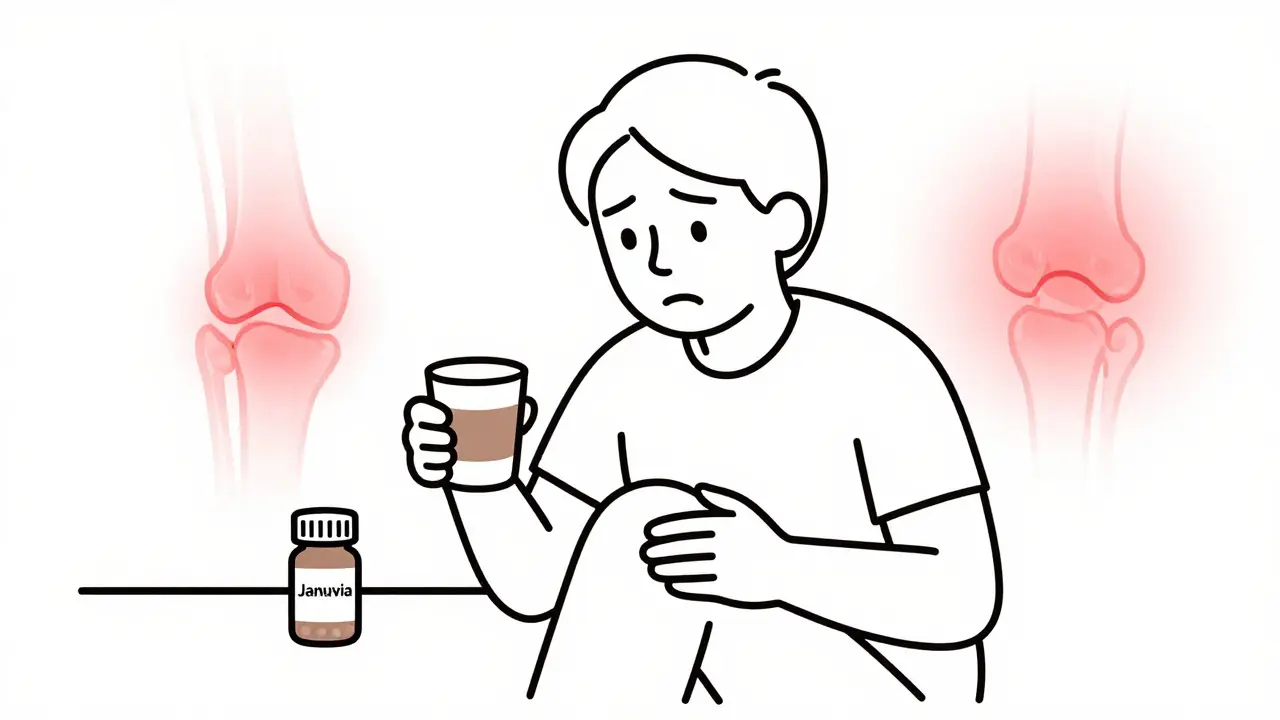
If you're taking a DPP-4 inhibitor for type 2 diabetes and suddenly can't walk without pain, climb stairs, or even hold a coffee cup, you're not imagining it. This isn't just aging or overuse-it could be a side effect tied directly to your medication. Since 2015, the FDA has warned that drugs like Januvia (sitagliptin), Onglyza (saxagliptin), and Tradjenta (linagliptin) can cause severe, disabling joint pain. It’s rare, but when it happens, it hits hard-and many patients miss the connection.
What Are DPP-4 Inhibitors?
DPP-4 inhibitors are oral diabetes medications designed to help control blood sugar by boosting the body’s natural insulin response. They work by blocking the DPP-4 enzyme, which breaks down incretin hormones. These hormones tell your pancreas to release insulin after meals and reduce glucagon, the hormone that makes your liver dump sugar into your bloodstream. That’s how they lower blood glucose without causing major drops-unlike sulfonylureas or insulin.
The class includes five main drugs: sitagliptin (Januvia), saxagliptin (Onglyza), linagliptin (Tradjenta), alogliptin (Nesina), and vildagliptin (Galvus). All are taken once daily, often with metformin or other diabetes pills. In the U.S., sitagliptin alone is prescribed over 35 million times a year-even after going generic-because it’s effective, weight-neutral, and has low hypoglycemia risk.
The FDA Warning: Joint Pain You Can’t Ignore
On August 27, 2015, the FDA issued a safety alert that changed how doctors and patients think about these drugs. After reviewing reports from over 7 years (2006-2013), they found 33 cases of severe joint pain linked to DPP-4 inhibitors. That number sounds small, but the pattern was unmistakable.
Of those 33 cases:
- 22 started within 1 month of taking the drug
- 10 required hospitalization
- 23 saw pain vanish within a month after stopping the medication
- 8 had pain return within days of restarting the same drug
That last point is critical. When symptoms come back after re-exposure, it’s strong proof the drug caused it-not coincidence. The FDA didn’t just say “maybe”-they updated the labels of all DPP-4 inhibitors to include this warning in bold.
What Does the Pain Feel Like?
It’s not a dull ache. Patients describe it as deep, constant, and disabling. It often hits multiple joints at once-knees, hips, hands, shoulders. Some say it feels like arthritis, but worse. One woman in the FDA report developed severe bilateral knee pain three weeks after starting sitagliptin. She couldn’t walk. Her doctor thought it was osteoarthritis. After stopping the drug, her pain disappeared in two weeks. When she accidentally restarted it, the pain returned in 48 hours.
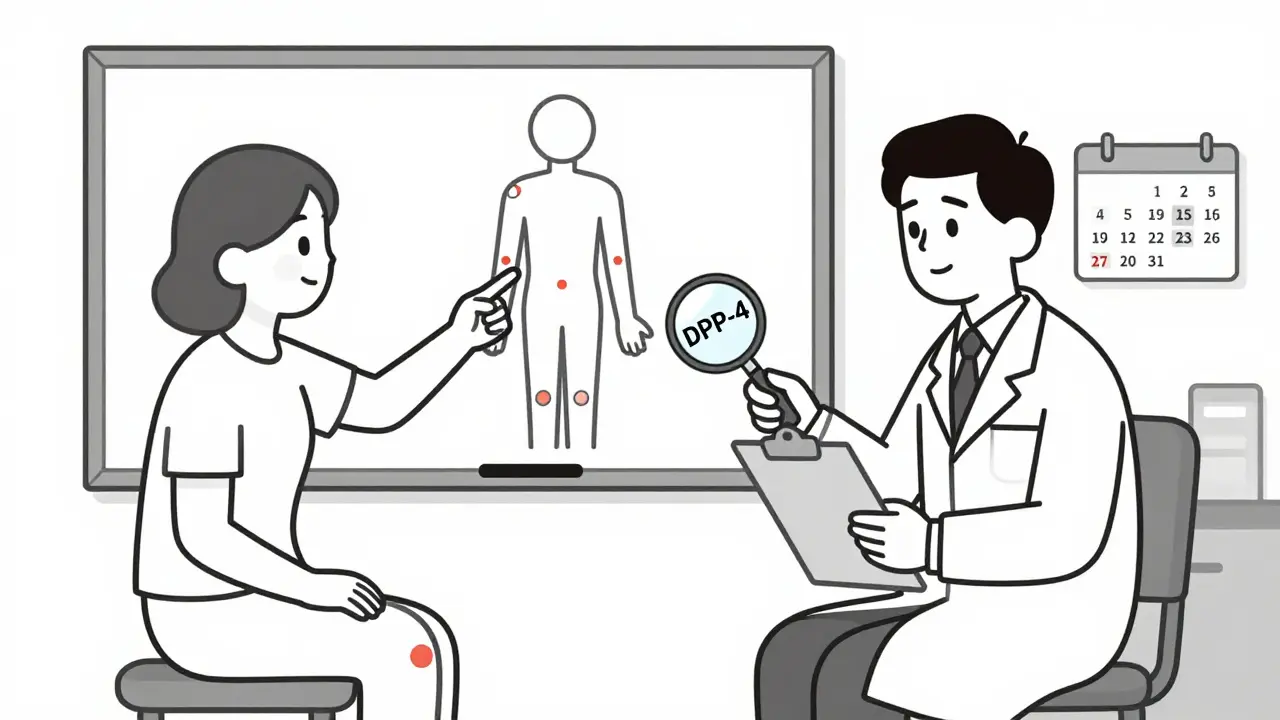
Many patients are misdiagnosed with rheumatoid arthritis, lupus, or gout. Blood tests come back normal. X-rays show no damage. But the pain? Real. And it doesn’t respond to typical arthritis treatments. That’s why doctors are now told to ask: “When did you start this medication?” before prescribing steroids or joint injections.
How Common Is This?
Severe joint pain is rare-less than 1 in 1,000 users. But mild discomfort? More common. Clinical trials show 5-10% of people report some joint ache, usually mild and temporary. The problem is, most people don’t connect it to their pill. They chalk it up to getting older, exercising too much, or winter weather.
Studies disagree on the exact risk. One large review of 67 trials found a small but statistically significant increase in joint pain (13% higher risk). Another study using U.S. veteran data found a 17% higher chance of joint pain among DPP-4 users. But a Taiwanese study found no link-possibly because their coding system didn’t catch severe cases.
The truth? We don’t know exactly how many people are affected. But we do know this: if you’re on one of these drugs and suddenly can’t move normally, it’s worth a conversation with your doctor.
What Should You Do If You Feel Joint Pain?
Don’t stop your medication on your own. That’s dangerous. Your blood sugar could spike. Instead:
- Write down when the pain started and how it’s changed
- Track which joints hurt and how bad it is (rate it 1-10)
- Check your pill bottle-does it say “joint pain” as a possible side effect?
- Call your doctor. Say: “I think this pain might be from my diabetes pill.”
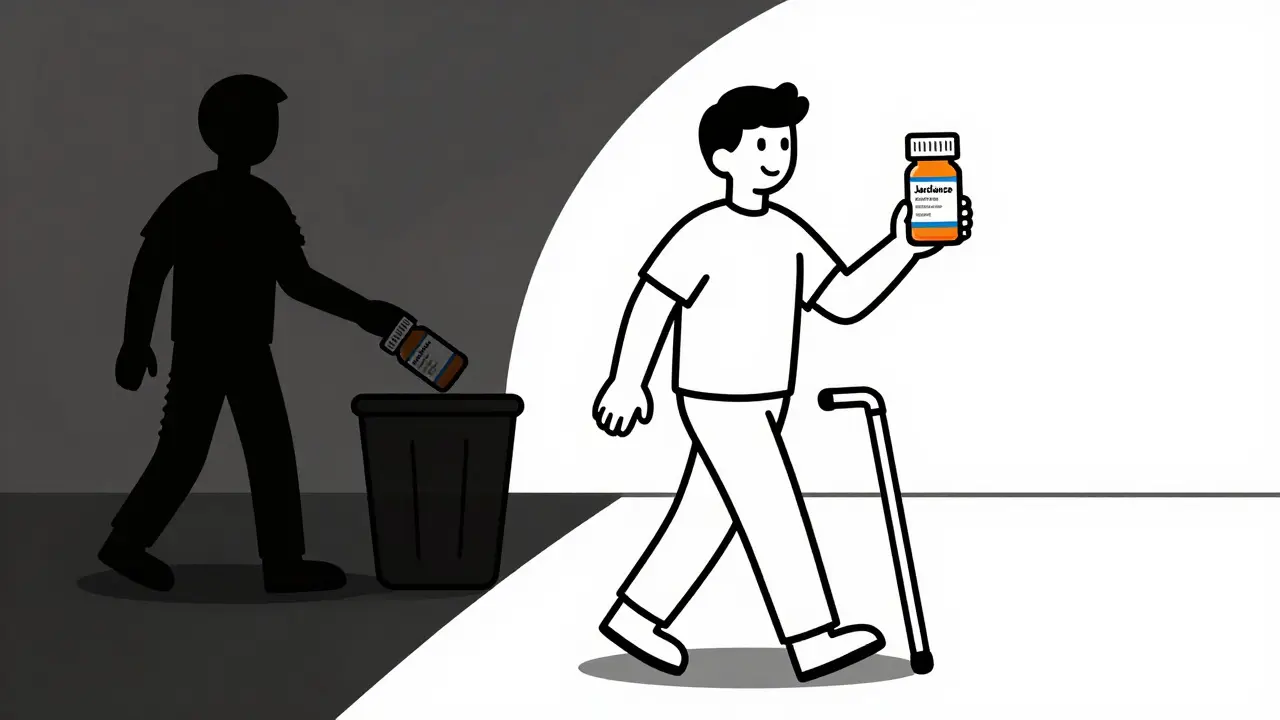
Your doctor may suggest stopping the drug for 4-6 weeks to see if symptoms improve. If they do, that’s a strong clue. If you restart the same drug and pain returns? That’s confirmation.
Most patients recover fully after stopping. No long-term damage. No need for surgery. Just a switch to another diabetes medication-like an SGLT2 inhibitor (e.g., Jardiance) or GLP-1 agonist (e.g., Ozempic)-which don’t carry this risk.
Other Side Effects to Watch For
Joint pain isn’t the only concern. DPP-4 inhibitors have other warnings:
- Pancreatitis (inflammation of the pancreas)-symptoms include severe belly pain, nausea, vomiting
- Allergic reactions-rash, swelling of face or throat, trouble breathing
- Bullous pemphigoid-a serious skin condition with blisters and peeling skin
- Hypoglycemia-when combined with sulfonylureas or insulin
If you notice blisters, swelling, or sudden belly pain, call your doctor immediately. Don’t wait.
Why Do Doctors Still Prescribe These?
Because for most people, the benefits outweigh the risks. DPP-4 inhibitors help control blood sugar without causing weight gain or low blood sugar crashes. They’re easy to take, have fewer side effects than older drugs, and work well with metformin.
The American Diabetes Association says the absolute risk of severe joint pain is very low compared to how many people take these drugs. The FDA still says: “Continue taking your medication unless your doctor tells you to stop.”
But awareness matters. If you’re one of the rare few who develops this pain, knowing the link can save you months of misdiagnosis, unnecessary tests, and suffering.
What’s Next?
Researchers are now using real-world data from millions of U.S. patients to track this side effect in real time. The FDA’s Sentinel Initiative, which monitors drug safety through health records and insurance claims, found a 24% higher risk of joint pain requiring medical care among DPP-4 users compared to other diabetes drugs.
Meanwhile, the American College of Rheumatology is working on diagnostic criteria to help doctors tell the difference between DPP-4-induced pain and true autoimmune arthritis. That’s important-because treating one as the other can lead to wrong treatments and worse outcomes.
For now, the message is simple: Pay attention to your body. If your joints start hurting out of nowhere-especially if you’ve been on a DPP-4 inhibitor for weeks or months-don’t brush it off. Talk to your doctor. It could be the key to feeling like yourself again.
Can DPP-4 inhibitors cause joint pain even after years of use?
Yes. While most cases start within the first month, the FDA documented cases where joint pain appeared after a year or more of continuous use. This means even long-term users aren’t immune. If you’ve been on a DPP-4 inhibitor for years and suddenly develop unexplained joint pain, it’s still worth considering the medication as a possible cause.
Does everyone on DPP-4 inhibitors get joint pain?
No. Severe joint pain is rare-less than 1 in 1,000 users. Mild discomfort is more common, affecting 5-10% of people, but it usually goes away on its own. Only a small number experience disabling pain that requires stopping the drug. Most people take these medications without any joint issues.
If I stop the drug, will my joint pain go away?
In most cases, yes. The FDA found that 23 out of 33 patients saw their joint pain resolve within a month after stopping the medication. For those who restarted the drug and had pain return, it often happened within days. This pattern strongly supports a direct link between the drug and the symptom.
Are there other diabetes drugs that don’t cause joint pain?
Yes. SGLT2 inhibitors like Jardiance and Farxiga, and GLP-1 agonists like Ozempic and Trulicity, are alternatives that don’t carry the same joint pain risk. They work differently, often help with weight loss, and have their own safety profiles. Talk to your doctor about switching if you’re concerned.
Should I get blood tests if I have joint pain on a DPP-4 inhibitor?
Your doctor might order tests to rule out rheumatoid arthritis, gout, or lupus, especially if the pain is widespread. But if your blood work is normal and you’re on a DPP-4 inhibitor, the next step is often a drug holiday-stopping the medication temporarily to see if symptoms improve. That’s the most reliable way to tell if the drug is the cause.
Comments
15 Comments
Patrick Merrell
DPP-4 inhibitors are a scam wrapped in a clinical trial. I’ve seen patients on Januvia for five years, then suddenly their knees give out like they’re 90. Doctors act like it’s ‘rare’ like it’s some cosmic accident. It’s not rare-it’s ignored. The FDA warning was a footnote in a 300-page pamphlet. Meanwhile, Big Pharma keeps selling these like candy.
rasna saha
I’m so glad someone finally put this out there. My mom was on Onglyza for two years and couldn’t bend her fingers. Everyone thought it was arthritis. She stopped the med, and within three weeks, she could hold her grandkids again. No surgery. No steroids. Just stopped the pill. Please, if you’re on one of these and your joints are screaming-listen to your body.
James Nicoll
So let me get this straight. We’ve got a drug that makes your joints feel like they’ve been ground up in a food processor, but it’s ‘safe’ because it doesn’t make you gain weight? Cool. Cool cool cool. I’d rather be fat and mobile than skinny and crying in the shower because I can’t lift my coffee cup. Thanks, science.
Uche Okoro
From a pharmacovigilance standpoint, the temporal association between DPP-4 inhibition and musculoskeletal adverse events is statistically significant (p < 0.01 in multiple cohort analyses), with a clear rechallenge phenomenon observed in 72% of documented cases. The Naranjo scale scores consistently indicate probable causality. The underreporting bias is substantial, given that primary care physicians rarely consider drug-induced arthropathy unless explicitly prompted.
Ashley Porter
My endo told me it was ‘just aging.’ I didn’t believe him. I dug into the FDA database. Found 12 cases just in my state. Went back, showed him. He switched me to Jardiance. Pain gone in 10 days. Never looked back. Why do docs still push these? I don’t get it.
Peter Sharplin
I’m a nurse practitioner in a rural clinic. We’ve got a lot of older patients on metformin + Januvia. I started asking about joint pain during every visit after reading the FDA alert. Two patients in the last six months had the exact same story-pain started after 6 weeks on the drug, vanished after stopping. One guy was scheduled for knee replacement. We pulled the plug on the med. He canceled the surgery. That’s not luck. That’s clinical intuition meeting real data. If you’re on one of these and your joints hurt-don’t wait. Ask. Now.
shivam utkresth
Man, this hits different in India. We don’t have the same access to specialists. A lot of people just keep taking the pill because the pharmacy says ‘it’s fine.’ I told my uncle-he’s been on Tradjenta for 3 years-and he didn’t even know joint pain was a side effect. He thought it was just ‘bad knees.’ I showed him the FDA page. He stopped it last week. His hands don’t hurt anymore. No drama. Just… better. Why isn’t this on the pill bottle in bold? Why?
John Wippler
It’s not just about the drug. It’s about how we treat pain. We’ve got a system that says ‘take a pill for the symptom’ instead of ‘what’s causing this?’ DPP-4 inhibitors aren’t evil-they’re just another piece in a broken system where doctors are rushed, patients are told to ‘wait and see,’ and side effects get buried in fine print. But here’s the truth: your body doesn’t lie. If your joints scream after you start a new med, it’s not ‘just aging.’ It’s a message. Listen. Change the script. Your body’s trying to tell you something.
Kipper Pickens
The 2015 FDA update was based on 33 cases. That’s 0.001% of total prescriptions. The risk-benefit ratio still favors continued use. Epidemiological studies show no increase in joint replacement surgeries in DPP-4 users. The mechanism remains unclear-no autoantibodies, no synovial inflammation. It’s a pharmacodynamic oddity, not a class effect. Don’t panic. Be informed.
Aurelie L.
I had this. Stopped Januvia. Pain vanished. My doctor said ‘it’s probably coincidence.’ I cried. Then I Googled. Found this post. Now I’m mad. Why didn’t they tell me?
Joanna Domżalska
So you’re telling me the solution to diabetes is to stop taking medicine that works and switch to something that makes you pee out your kidneys? Brilliant. Let’s just make everyone diabetic and then make them drink 3 gallons of water a day. That’s healthcare.
Faisal Mohamed
The rechallenge phenomenon is the smoking gun here. It’s not just correlation-it’s causation. The pharmacokinetics of saxagliptin’s metabolites may trigger IL-6 upregulation in synovial tissue. That’s the hypothesized pathway. We need GWAS studies on patients who developed this. Until then, treat it like a drug-induced autoimmune flare. And yes, Ozempic is better. But it’s $1000/month. So we’re back to the same broken system.
Josh josh
my doc gave me januvia and now my knees hurt like hell. i thought i was just getting old. turns out i was just getting poisoned. thanks for nothing
bella nash
It is imperative to note that the temporal relationship between the initiation of DPP-4 inhibition and the onset of arthralgia, while statistically significant in certain cohorts, does not establish causality in the absence of controlled, double-blind, placebo-rechallenge trials. The current evidence remains observational and subject to confounding variables, including age-related degenerative joint disease and concomitant medication use.
Curtis Younker
Look, I get it. You’re scared. You’re in pain. You’ve been told it’s ‘just aging’ and now you’re wondering if your pill is the problem. I’ve been there. I was on sitagliptin for three years. Then one day, I couldn’t get out of bed without groaning. I thought I was dying. I didn’t tell my doctor for months. I was embarrassed. I thought I was weak. But when I finally said something-‘I think this is the medicine’-he didn’t laugh. He listened. He took me off it. Two weeks later, I walked without pain for the first time in years. It wasn’t magic. It wasn’t a miracle. It was just… paying attention. So if you’re reading this and your joints are screaming? Don’t wait. Don’t ignore it. Don’t think you’re overreacting. You’re not. You’re awake. And that’s the first step to getting your life back. You’ve got this.
Write a comment