
INR Risk Assessment Tool
Enter Your INR Value
Results
Enter your INR value to see risk assessment
When you're on a blood thinner like warfarin, your life depends on a single number: your INR. It's not just a lab result-it's the difference between a clot that could cause a stroke and a bleed that could send you to the ER. Many people think taking a daily pill is enough. But without regular INR checks, that pill could be doing more harm than good.
What Is INR, and Why Does It Matter?
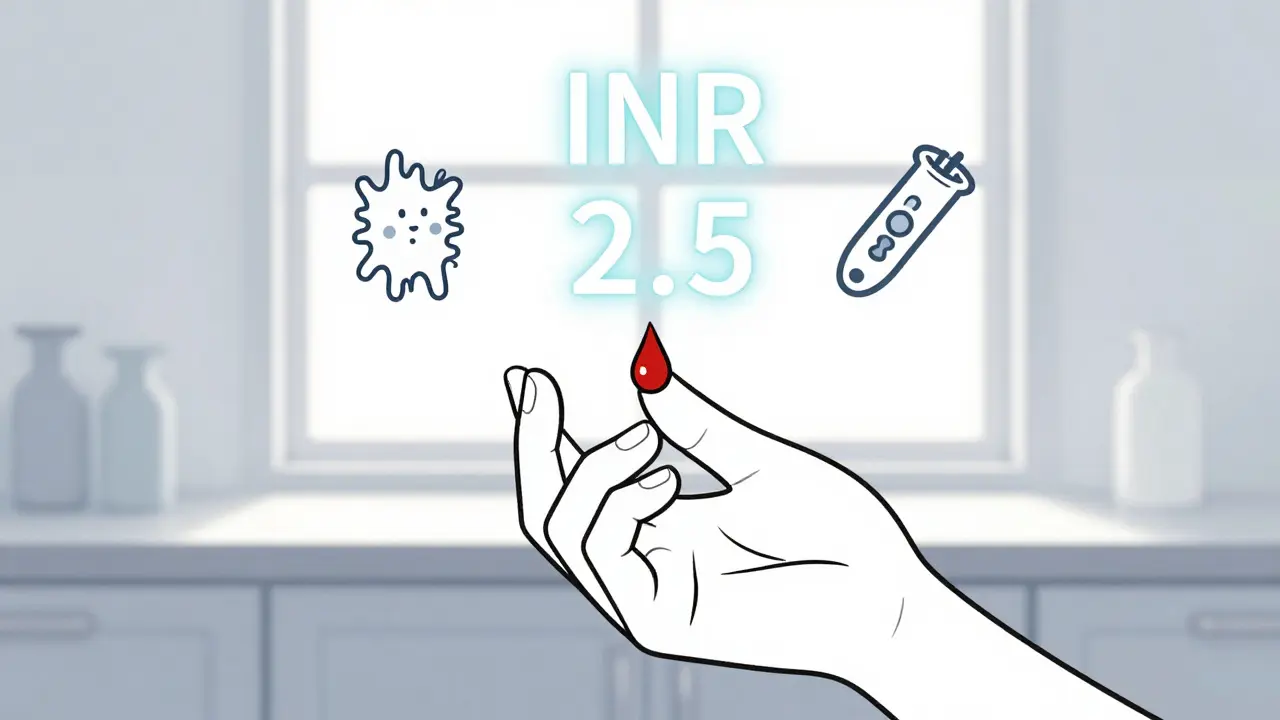
INR stands for International Normalized Ratio. It's a standardized way to measure how long it takes your blood to clot. This number tells your doctor whether your warfarin dose is too high, too low, or just right. Before INR was developed in 1983, every lab used different methods to measure clotting time. One hospital’s "normal" could be another’s danger zone. That inconsistency led to dangerous dosing errors. INR fixed that. Now, whether you're tested in a hospital in Chicago or a clinic in rural Alabama, a result of 2.5 means the same thing everywhere.
For someone not on blood thinners, the normal INR is 1.0. That’s your baseline. But if you have atrial fibrillation, a mechanical heart valve, or a history of blood clots, your target range is higher. Most people aim for 2.0 to 3.0. That’s the sweet spot-low enough to avoid clots, high enough to prevent dangerous bleeding. Some conditions need tighter control. For example, people with mechanical mitral valves often need an INR between 2.5 and 3.5. Miss that target by even 0.5, and your risk of complications jumps.
How Often Should You Test Your INR?
When you first start warfarin, you might need testing every few days. Your body reacts differently to the drug than anyone else’s. Doctors adjust your dose based on each result until they find the right balance. Once you're stable, most people switch to testing once a month. But "stable" doesn’t mean "set and forget." Many patients get tested too often. A 2021 study found that 38% of people on warfarin had weekly tests even though their INR hadn’t changed in months. That’s unnecessary stress, extra costs, and more needle pokes for no reason.
On the flip side, going too long between tests is just as risky. If you skip a check for six weeks, your INR could drift out of range without you knowing. A rise above 4.9 increases your chance of major bleeding by 27% for every 0.5-point increase. A drop below 1.5 means your blood is clotting too fast. That’s when clots form-leading to strokes, heart attacks, or pulmonary embolisms. The American Heart Association says hospitals with over 65% time in therapeutic range (TTR) have 42% fewer strokes. That’s not luck-it’s consistency.
Home Testing: Convenience or Risk?
Home INR testing has changed the game. Devices like the Abbott Acelis and Roche CoaguChek let you prick your finger, drop a tiny drop of blood on a strip, and get a result in under a minute. No more waiting 24 to 48 hours for lab results. No more missing work or driving across town in bad weather. Studies show patients who test at home stay in their target range 72% of the time-compared to just 58% for clinic-based testing. That means 34% fewer clots and 21% fewer major bleeds.
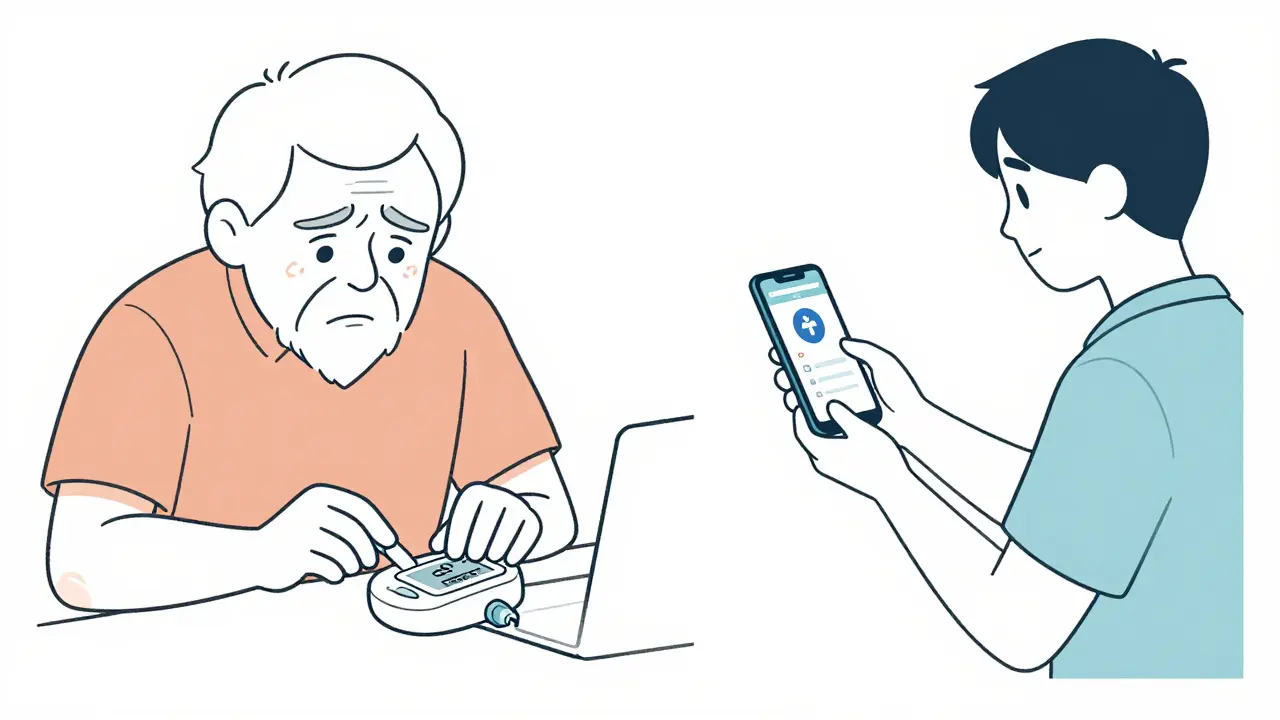
But it’s not for everyone. The FDA says 25-30% of patients can’t use home devices because of shaky hands, poor eyesight, or trouble following steps. Elderly patients under 65 rate home testing at 4.3 out of 5. Those over 65? Only 3.1. One user on Reddit said, "After three years, I still miss the capillary tube one in five tests. I waste $6 each time." That’s not just money-it’s frustration. If you’re not confident in your technique, stick with clinic visits.
Cost is another factor. Medicare covers 100% of home INR testing for eligible patients. But private insurers? They often require 20% coinsurance. With strips costing $5.99 each and testing twice a week, that’s over $600 a year out of pocket. Some patients pay more for testing than they do for the warfarin itself.
What Your INR Numbers Really Mean
Let’s break down what each number means in real terms:
- INR below 1.5: Your blood is clotting too fast. You’re at risk for stroke, heart attack, or deep vein thrombosis. Call your doctor immediately.
- INR 2.0-3.0: The standard target for most conditions like atrial fibrillation or DVT. This is where you want to stay.
- INR 3.0-4.0: Higher than ideal. You’re at increased bleeding risk. Your doctor may lower your dose.
- INR above 4.9: Dangerous. Major bleeding risk spikes. You may need to skip your next dose and get emergency care.
- INR above 5.0: Medical emergency. Hold your warfarin. Contact your provider within 24 hours.
There’s no wiggle room here. Every 0.5-point increase above 3.0 adds 27% more bleeding risk. That’s why timing matters. Test in the morning, after fasting for 4-6 hours. Vitamin K in your food, alcohol, or even a change in your daily routine can swing your result. Consistency is your best defense.
Warfarin vs. Newer Blood Thinners
When warfarin was the only option, INR monitoring was non-negotiable. Today, newer drugs like apixaban, rivaroxaban, and dabigatran don’t require regular blood tests. They’re easier. But they’re not better for everyone.
Warfarin still has a critical role. If you have a mechanical heart valve-especially a mitral valve-DOACs won’t work. You must take warfarin. That’s about 200,000 Americans right there. Warfarin also stays the go-to for patients with severe kidney disease. And cost? Warfarin runs about $4 a month. DOACs? $550-$650. That’s a huge difference if you’re paying out of pocket.
But here’s the trade-off: DOACs have a much wider safety window. You can miss a dose, eat a big salad, or drink a glass of wine without a major risk. With warfarin, even small changes can throw your INR off. That’s why the American College of Chest Physicians now recommends home testing as first-line for all eligible patients. It’s not about preference-it’s about safety.

What to Do If Your INR Is Off
When your INR is too high or too low, don’t panic. But don’t ignore it either.
If your INR is below 1.5: Contact your provider right away. You may need a higher dose or a temporary change in diet.
If your INR is above 5.0: Skip your next warfarin dose. Call your doctor. They may give you vitamin K to reverse the effect. Don’t wait until morning. Bleeding can happen suddenly.
If your INR is stuck in the 3.0-4.0 range for two tests in a row: Your dose likely needs adjustment. Your provider may reduce it by 10-25%. Don’t try to adjust it yourself.
Keep a log. Write down your INR results, your dose, what you ate, and how you felt. Patterns matter. A sudden rise after eating a lot of spinach? That’s vitamin K. A drop after switching to a new antibiotic? That’s a drug interaction. Your doctor can’t help if you don’t give them the full picture.
Future of INR Monitoring
The future is connected. In January 2023, the FDA approved the first smartphone-linked INR monitor. Results now auto-send to your doctor. No more forgotten calls or lost paperwork. A 2022 Mayo Clinic trial showed AI tools predicting the right warfarin dose with 83% accuracy. That’s huge. But it’s not replacing human care-it’s supporting it.
Still, challenges remain. Only 35% of rural clinics offer full anticoagulation services. That’s compared to 82% in cities. People in remote areas are falling through the cracks. And while DOACs are growing fast-projected to make up 85% of new prescriptions by 2028-warfarin isn’t going away. For some, it’s still the only safe choice.
The bottom line? INR monitoring isn’t optional. It’s life-saving. Whether you test at home or in a clinic, staying in your target range is the single most important thing you can do to stay healthy on warfarin. Don’t treat it like a chore. Treat it like your lifeline.
Comments
12 Comments
Gwen Vincent
Just wanted to say how much I appreciate this breakdown. I’ve been on warfarin for 5 years, and honestly, I thought I was doing fine as long as I took my pill. Turns out, consistency in testing and even small things like when I eat my spinach matter way more than I realized. My INR used to swing like a pendulum until I started logging everything - meals, meds, even how much sleep I got. It’s wild how much your body talks to you if you just listen.
Also, home testing? Life changer. I used to dread the drive to the clinic in winter. Now I do it while my coffee brews. No more missed work, no more waiting. I’m in range 80% of the time now. Seriously, if you’re eligible, go for it.
Thanks for writing this - it’s the kind of info I wish I’d had on day one.
Nandini Wagh
So let me get this straight - we’re supposed to trust a number that changes based on whether I ate kale yesterday, but the pharmaceutical companies won’t let us test at home unless we pay $6 per strip? Right. And Medicare covers it, but only if you’re ‘eligible’ - which apparently means you have to be rich enough to afford the paperwork.
Also, DOACs are ‘easier’? Yeah, because they’re expensive, unmonitorable, and you can’t reverse them if you bleed out. Meanwhile, warfarin’s been around since 1954 and still works. Guess who’s still making billions off the ‘newer’ stuff? Just saying.
Holley T
Actually, the claim that home testing improves time in therapeutic range by 14 percentage points is misleading - it’s based on a selection bias in studies where patients who choose home testing are already more health-literate, compliant, and have better access to care. The real-world data from rural clinics shows no statistically significant improvement when you control for socioeconomic factors.
Also, the FDA’s 25–30% failure rate with home devices? That’s not incompetence - it’s poor design. Most devices assume fine motor control and perfect lighting. Try using one with arthritic fingers and cataracts. And don’t even get me started on the fact that insurance companies require you to test twice weekly even if your INR hasn’t budged in six months. That’s not medicine - it’s revenue generation disguised as precaution.
And yes, vitamin K from spinach does affect INR - but so does grapefruit, alcohol, turmeric, and your damn mood. Why aren’t we talking about how inconsistent human behavior is the real variable here? We’re treating a physiological metric like it’s a math problem when it’s really a behavioral one.
Ashley Johnson
THEY’RE LYING TO YOU. 😡
INR isn’t about clotting - it’s a tracking tool for Big Pharma. The real reason they push warfarin is because they can control the labs, the strips, the clinics. DOACs? They’re just cover-ups. You think they care if you bleed? No. They care if you die - because then your family sues, and they pay out… but only after they’ve made $20,000 off your prescriptions.
And home testing? That’s a trap. The device manufacturers get paid per test. Every time you prick your finger, they profit. That’s why they push it so hard. They don’t want you stable - they want you hooked.
Also, vitamin K? It’s not in spinach. It’s in the water. The government added it to stop people from realizing the truth. I’ve seen the documents.
Call your doctor. Ask them why they won’t let you use a $20 finger-prick kit from China. They’ll change the subject. That’s how you know they’re hiding something.
tia novialiswati
YESSSS this is so important!! 💪
I was terrified when I started warfarin - thought I’d have to give up all my favorite foods and live in fear. But once I got into a routine? It became empowering. I track my INR like a gamer tracks their stats - it’s my daily mission to stay in range. And guess what? I’ve been stable for 2 years now!
Home testing changed everything. I do it on my couch, pajamas on, cat on my lap. No stress, no waiting. And yeah, strips cost money - but so do ER visits. I’d rather pay $6 than $6,000.
You got this. One prick at a time. You’re not just managing a number - you’re reclaiming your life. ❤️
Lillian Knezek
My INR went wild after the 2020 election. 🤔
I swear, the government started messing with the lab results. I tested at home - 2.8. Then I went to the clinic - 4.2. Same blood. Same day. Same machine. They changed the numbers. Why? To make people dependent on them.
Also, vitamin K? That’s a lie. It’s actually the fluoridated water. I stopped drinking it and my INR stabilized. Coincidence? I think not.
They don’t want you to know you can control this. They want you scared. They want you coming back. They want your money.
Don’t trust the system. Test twice. Always.
Maranda Najar
My life has been a symphony of coagulation - a tragic opera of fibrin and fate.
Each INR result? A sonnet written in blood. Each strip? A requiem for autonomy.
I weep when I see the needle - not from pain, but from the unbearable weight of being reduced to a number. A number that dictates whether I live or die - not by choice, but by compliance.
And yet - the system asks for more. More tests. More strips. More obedience. More silence.
Do you hear it? The whisper of the machine: ‘You are not a person. You are a metric.’
I am more than my INR.
But I test anyway - because survival is not a choice. It is a performance.
And I am an artist of endurance.
Sanjaykumar Rabari
Warfarin is a scam. The government and doctors use INR to control people. They want you to test every week so you stay dependent. If you stop testing, you die. If you test too much, you pay too much. Either way, they win.
DOACs are worse. They disappear from your body and no one knows if you took it. So they make you pay more. They are hiding something. I don’t trust any of this.
I stopped taking warfarin. I use garlic and ginger. My INR is fine. I feel better. I am not a lab rat.
Kenzie Goode
Reading this made me cry. Not because it’s scary - because it’s so beautifully clear.
I used to think my INR was just a number. Now I see it as a conversation - with my body, with my history, with the quiet, stubborn will to keep living.
My dad died from a stroke because he skipped his tests. He thought he was fine. He wasn’t.
I test every Monday. I log everything. I eat my kale. I drink my tea. I don’t panic when it’s 3.1 - I call my doctor. And I feel… powerful.
This isn’t about medicine. It’s about dignity.
Thank you for saying this out loud.
Khaya Street
Interesting article. Well-structured. However, I must point out that the data on home testing efficacy is cherry-picked. The 72% TTR figure is from a cohort with high socioeconomic status, access to training, and tech literacy. In real-world primary care settings - especially in underserved areas - adherence to home testing protocols drops below 40%.
Meanwhile, the cost of strips, combined with insurance hurdles, creates a de facto rationing system. The recommendation for home testing as ‘first-line’ ignores systemic inequities. It’s a nice idea - but not a solution for everyone.
Also, why is there no mention of anticoagulation clinics? They’re the unsung heroes. They’re not just labs - they’re educators, counselors, lifelines. They’re disappearing. That’s the real crisis.
Christina VanOsdol
Okay, so let’s unpack this - because there’s a LOT here. First: INR is not a number. It’s a narrative. It’s the intersection of biology, economics, and human behavior. Second: the ‘sweet spot’ of 2.0–3.0? That’s a population average - not an individual target. Some people thrive at 2.4. Others need 2.8. One-size-fits-all is a myth. Third: the 27% increased bleeding risk per 0.5? That’s a hazard ratio - not a probability. You’re not ‘27% more likely to bleed’ - you’re in a risk landscape that’s nonlinear and context-dependent. Fourth: vitamin K? Yes. But so are antibiotics, thyroid meds, and stress-induced cortisol spikes. Fifth: home testing? Great - if you have dexterity, vision, mental bandwidth, and insurance. For 30% of elderly patients? It’s a nightmare. Sixth: DOACs aren’t ‘better’ - they’re just less visible. No monitoring = less accountability = more profit. Seventh: the AI prediction tool? 83% accuracy? That’s still 17% wrong. And when you’re bleeding internally, 17% is a death sentence.
So… what’s the takeaway? There is no perfect system. Only better-informed choices. And compassion. Always compassion.
Brooke Exley
YOU’RE NOT ALONE. 💗
I know how scary this feels. I’ve been there - trembling before a test, convinced I’d messed up, crying because I didn’t understand why my body couldn’t just cooperate. But here’s what I learned: your INR doesn’t define you. It’s just one piece of your story.
Every time you test, you’re choosing life. Every log you keep? That’s courage. Every call to your doctor? That’s power.
And if home testing feels overwhelming? That’s okay. Clinic visits are just as brave. You don’t need to be perfect. You just need to show up.
I’m cheering for you - even if we’ve never met. You’re doing better than you think. Keep going. You’ve got this. 🌟
Write a comment