

One bite of a contaminated salad. A handshake with someone who didn’t wash their hands after using the bathroom. A plate of oysters from a polluted bay. These aren’t just risky behaviors-they’re real ways hepatitis A spreads. And it’s not rare. Around 1.4 million people get hepatitis A every year worldwide. In the U.S., outbreaks still happen-not because of dirty water in poor countries, but because of food handled by someone who doesn’t know they’re sick.
How Hepatitis A Moves Through Food
Hepatitis A isn’t spread by coughing or sneezing. It’s spread by poop. Tiny, invisible bits of feces from an infected person get onto hands, then onto food, then into your mouth. This is called the fecal-oral route. And it’s terrifyingly efficient. As few as 10 to 100 virus particles can make you sick.Food handlers are the most common link in this chain. Studies show a single infected worker can contaminate dozens, even hundreds, of meals during a shift. The virus sticks to fingers, then transfers to lettuce, sandwiches, sushi, or cooked shrimp. One study found that nearly 10% of the virus on a contaminated finger moves to a piece of lettuce with just a light touch. That’s enough to start an outbreak.
It doesn’t need to be raw food. The virus survives cooking. It can live at 60°C (140°F) for a full hour. You need 85°C (185°F) for one minute to kill it. That means undercooked shellfish, like clams or oysters, are high-risk. So are salads, fruits, and sandwiches-anything handled bare-handed after the person has used the bathroom.
And the virus doesn’t die quickly. On stainless steel surfaces, it can survive for 30 days. In dried form, up to four weeks. In frozen food? It can last for years. That’s why outbreaks can pop up months after the original source was handled.
Who’s at Risk-and Why It’s Silent
You might think hepatitis A only hits travelers or people in developing countries. Not anymore. In places with good sanitation, like the U.S. and U.K., most cases now come from local foodborne outbreaks. The real danger? Most infected people don’t know they’re sick.Between 30% and 50% of adults with hepatitis A have no symptoms. Kids? Almost always symptom-free. But they can still spread the virus. An infected person becomes contagious one to two weeks before they feel sick. That means they’re working the grill, slicing bread, or serving coffee while shedding the virus in their stool. By the time they get jaundice (yellow skin), they’ve already passed it to others.
Outbreaks often go unnoticed until multiple people get sick. Then health departments scramble. A single outbreak can cost $100,000 to $500,000 to investigate. That’s not just lost wages-it’s restaurant closures, public panic, and lawsuits.
What Happens After Exposure
If you’ve been exposed-maybe you ate at a restaurant linked to an outbreak, or you’re a coworker who shared a bathroom with someone who got sick-you need to act fast. There’s a window: 14 days after exposure. After that, post-exposure prophylaxis (PEP) won’t work.There are two options for PEP:
- Hepatitis A vaccine (for people aged 1 to 40). One shot gives you protection for at least 25 years. It’s cheaper-$50 to $75 per dose-and builds long-term immunity.
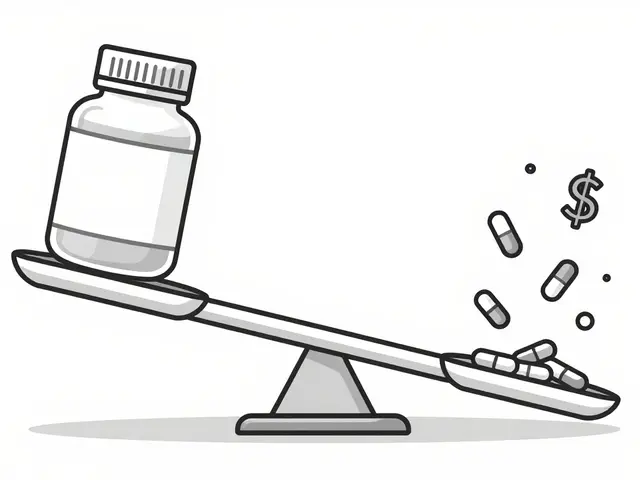
- Immune globulin (IG) (for everyone else, including kids under 1 and adults over 40). This is a shot of antibodies that gives you immediate, but temporary, protection-lasting only 2 to 5 months. It costs $150 to $300 per dose.
Neither option instantly stops the virus. You still need to wash your hands like your life depends on it-for at least six weeks. And if you’re a food worker? You can’t go back to handling food until at least 7 days after jaundice starts-or two weeks after symptoms begin, depending on your state’s rules.
California requires 14 days from symptom onset before returning to work. Iowa says 7 days after jaundice. There’s no national standard. That’s a problem.

Why Vaccines Aren’t Enough-Yet
The CDC has recommended hepatitis A vaccine for food handlers since the 1990s. But here’s the truth: fewer than 30% of food workers in the U.S. are vaccinated. In fast-food chains and seasonal jobs, it’s as low as 15%. Why?Turnover. In quick-service restaurants, staff turn over 150% a year. Someone gets hired, works two weeks, gets sick, and leaves. No one tracks their vaccination status. Language barriers make training hard. Many workers don’t even know the symptoms of hepatitis A. Surveys show only 35% can name them.
And handwashing? It’s supposed to be basic. But 78% of food establishments don’t enforce bare-hand contact rules. Only 42% use gloves or tongs for ready-to-eat food. And even when they do, 22% of kitchens don’t have enough handwashing stations. One station for every 15 employees? That’s the rule. Most places fall short.
Training matters. Hands-on demos improve compliance by 65%. But only 31% of restaurants use them. Most just hand out a pamphlet.
What’s Changing-And What Could Work
Things are slowly improving. Since 2020, employer-sponsored vaccination programs have grown by 17%. But they’re still mostly in fancy restaurants. Fast-casual spots? Only 18% offer it. Pop-up food vendors? Just 7%.More states are stepping in. As of January 2024, 14 U.S. states require hepatitis A vaccination for food handlers. California’s 2022 law prevented an estimated 120 infections and saved $1.2 million in outbreak costs. That’s a win.
New tools are coming. Researchers are testing wastewater monitoring in restaurants. They can detect the virus in sewage before anyone gets sick-89% accurate. Point-of-care blood tests are in Phase 3 trials and are 94% specific. If you could test a food worker in 10 minutes, you could stop outbreaks before they start.
Some places are trying financial incentives. Giving workers a $50 bonus for getting vaccinated increased uptake by 38 percentage points. That’s huge. For every $1 spent on prevention, you save $3.20 in outbreak costs.
What You Can Do
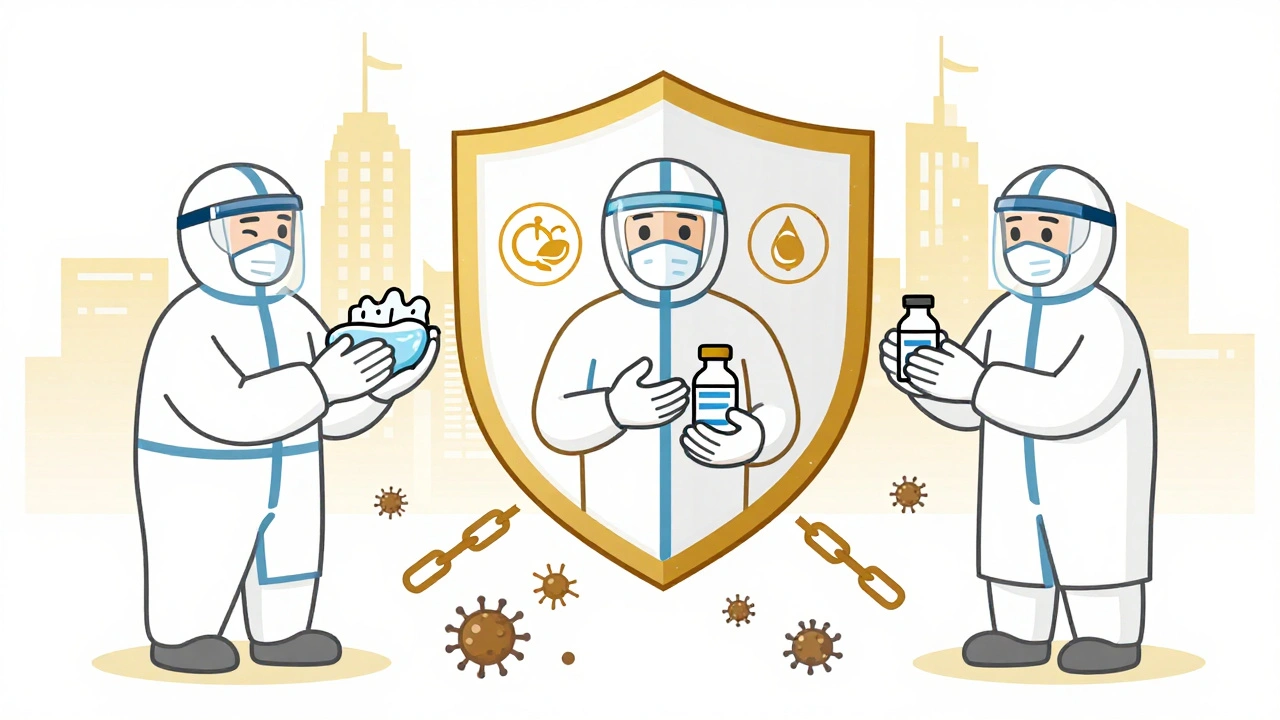
If you work with food:- Get vaccinated. Even if your employer doesn’t require it.
- Wash your hands with soap and water for 20 seconds-every time after the bathroom, before eating, before handling food. Water alone cuts risk by 30%. Soap cuts it by 70%.
- Use gloves or utensils. Never touch ready-to-eat food with bare hands.
- If you feel sick-nausea, fever, dark urine, yellow eyes-stay home. Don’t wait for a diagnosis.
If you eat out:
- Pay attention to hygiene. Are workers using gloves? Are there handwashing signs?
- Be cautious with raw shellfish, salads, and street food in places with poor sanitation.
- If you hear about an outbreak, check if you were there in the past two weeks. If yes, call your doctor. You may still have time for PEP.
What’s Next
The future of stopping hepatitis A isn’t just about medicine. It’s about systems. Vaccination linked to work permits. Real-time wastewater alerts. Mandatory training with live demos. Financial rewards for safety.Right now, we’re treating outbreaks like accidents. But they’re not. They’re preventable. Every time a food handler gets vaccinated, every time someone washes their hands properly, every time a restaurant uses gloves-we’re not just protecting one person. We’re protecting a whole community.
Can you get hepatitis A from cooked food?
Yes, if the food was contaminated before cooking and wasn’t heated to at least 85°C (185°F) for one minute. The virus survives temperatures up to 60°C (140°F) for an hour. That’s why undercooked shellfish and food handled by an infected person are high-risk-even if it’s served hot.
How long after exposure should you get the hepatitis A vaccine?
Within 14 days of exposure. After that, the vaccine won’t prevent infection. But it still helps protect you from future exposures. If you’re over 40, pregnant, or have a weakened immune system, immune globulin is recommended instead.
Can you get hepatitis A more than once?
No. Once you recover from hepatitis A, your body develops lifelong immunity. The vaccine also provides long-term protection-at least 25 years. You don’t need booster shots.
Is hepatitis A dangerous?
For most healthy people, it’s not. Symptoms like fatigue, nausea, and jaundice usually go away in weeks. But it can be serious for older adults and people with liver disease. In rare cases, it causes liver failure. The bigger danger is how easily it spreads-especially in food service.
Do I need the hepatitis A vaccine if I’ve had it before?
No. If you’ve had a confirmed hepatitis A infection, you’re immune for life. You don’t need the vaccine. But if you’re unsure, a blood test can check for antibodies. If you’ve never been infected or vaccinated, get the shot-it’s safe and effective.
Can hepatitis A spread through water?
Yes, but in developed countries like the U.S. and U.K., tap water is treated and safe. Outbreaks from water usually happen in places without proper sewage systems. In the U.S., nearly all recent outbreaks are foodborne, not waterborne.
How do you know if you have hepatitis A?
A blood test checks for HAV IgM antibodies. These show up 5-10 days before symptoms and last 3-6 months. If you’re sick with nausea, fever, dark urine, or yellow skin, and you’ve been exposed to food or someone with hepatitis A, ask your doctor for this test.
Stopping hepatitis A isn’t about fear. It’s about action. Clean hands. Vaccines. Gloves. Training. Systems that work. We know how to stop it. Now we just need to do it-consistently, everywhere.
Comments
11 Comments
pallavi khushwani
you know, it’s wild how something so small-like a speck of poop on a finger-can ripple through entire communities. we’re so disconnected from the biology of our daily lives. i think we need to stop seeing hygiene as a chore and start seeing it as a sacred act of care. not just for ourselves, but for the person behind the counter, the kid eating that sandwich, the elderly neighbor who can’t fight off infections like we can.
Billy Schimmel
so let me get this straight-we pay $300 for a shot that lasts 5 months, but the vaccine that lasts 25 years is only $75… and yet restaurants still let people handle food bare-handed because ‘it’s faster’? wow. just wow.
Dan Cole
Let me be unequivocally clear: the failure to mandate universal hepatitis A vaccination for all food service workers is not negligence-it is systemic malfeasance. The CDC’s 1990s recommendation was a tepid suggestion, not a regulatory imperative. We have a pathogen that survives 30 days on stainless steel, replicates at concentrations as low as 10 virions, and is shed asymptomatically by 50% of infected adults. To treat this as a personal responsibility issue rather than a public health emergency is to misunderstand the very definition of epidemiology. This is not a ‘hygiene problem.’ It is a governance failure.
Furthermore, the notion that ‘handwashing signs’ are sufficient deterrents is laughable. Human behavior is not governed by signage-it is governed by structure, enforcement, and consequence. The fact that 78% of establishments do not enforce bare-hand contact rules reveals a culture of institutional apathy. And yet, we marvel when outbreaks occur? Shocking.
Wastewater surveillance? Brilliant. Point-of-care diagnostics? Long overdue. But without mandatory vaccination tied to employment certification, these are all just expensive band-aids on a severed artery. We do not allow unvaccinated individuals to teach children. We do not allow unlicensed electricians to rewire homes. Why, then, do we permit unvaccinated individuals to prepare our food?
And don’t get me started on the ‘financial incentive’ model. Paying people $50 to do what they should be legally required to do is not innovation-it is moral capitulation. The state must act. Now.
Kay Jolie
Oh my god, I just realized-I ate at that taco truck last week. The guy was wiping his nose with his sleeve, then tossing cilantro on my carnitas. I’m pretty sure I’ve been incubating since Tuesday. I mean, I’ve had mild nausea, but I thought it was just the guac. 😭
But seriously-this is why I refuse to eat anything from a food cart unless they’re wearing gloves. I don’t care if it’s ‘authentic’ or ‘artisanal.’ If I can’t see a barrier between human skin and my food, I’m walking away. I’d rather eat a sad frozen meal than risk becoming a statistic.
And the fact that California’s law prevented 120 infections? That’s not policy-that’s a miracle. Why isn’t this federal law? Why aren’t we yelling about this on every news channel? We have the tools. We have the data. We have the science. We just don’t have the will.
Also, can we talk about how the phrase ‘wash your hands’ is now a cultural punchline? Like, people do the ‘handwashing dance’ on TikTok while covered in glitter and call it ‘self-care.’ Meanwhile, a single food worker with poor hygiene could be responsible for 200 cases. We’ve turned survival into a meme.
I’m not even mad. I’m just… profoundly disappointed in humanity.
Shayne Smith
my cousin works at a burger joint and she got the vaccine last year-her boss paid for it. she said it was the first time anyone ever asked if she wanted to be protected. she cried. i cried. we need more bosses like that.
Clare Fox
so like… if you get the shot after exposure, you still gotta wash your hands for 6 weeks? so the shot doesn’t even stop you from spreading it? then what’s the point? i feel like we’re all just playing whack-a-mole with germs and pretending we’re winning.
also, i think the real problem is we treat food workers like robots. like if they’re tired or sick or stressed, they just gotta push through. but they’re humans. with hands. and bathrooms. and sometimes, they forget to wash. it’s not evil. it’s exhaustion.
maybe instead of blaming them, we should give them breaks. paid sick days. actual training. not just a pamphlet. like… imagine if we treated them like the heroes they are instead of the invisible people they’re treated as.
Katie O'Connell
It is imperative to note that the proliferation of informal food service economies-particularly those operating under the auspices of ‘pop-up’ or ‘artisanal’ branding-has created a regulatory vacuum of unprecedented scale. The absence of standardized vaccination protocols, coupled with the normalization of bare-hand contact, constitutes a direct affront to the principles of public health ethics. The notion that ‘it’s just one person’ is a dangerous fallacy; each asymptomatic carrier is a vector of systemic risk. Furthermore, the reliance on voluntary compliance in an industry characterized by high turnover and linguistic heterogeneity is not merely inefficient-it is ethically indefensible. We must institutionalize vaccination as a condition of licensure, not a privilege.
Akash Takyar
Dear friends, I have read this post with deep attention. It is true that hepatitis A is not just a disease-it is a mirror of our society's values. When we allow someone to handle food without protection, we are saying: 'Your health is less important than speed.' When we do not vaccinate, we are saying: 'I am afraid to pay a little, so you must risk everything.' Let us not wait for tragedy to change us. Let us act now-with kindness, with clarity, with courage. One handwash. One vaccine. One decision. It matters.
Inna Borovik
Let’s be real-this whole post is just a fearmongering op-ed disguised as public health advice. The odds of you getting hepatitis A from food are lower than getting struck by lightning while winning the lottery. And yet here we are, turning a 1.4 million case global disease into a national emergency because some food handler didn’t wash his hands.
Also, the ‘$50 bonus for vaccination’? That’s just corporate greenwashing. They’re not doing it to save lives-they’re doing it because they’re scared of lawsuits. And don’t get me started on wastewater testing. That’s a $2 million experiment for a virus that’s easily preventable with… wait for it… hand soap.
Meanwhile, real public health crises-like opioid overdoses or maternal mortality-are getting ignored because this one is ‘visceral.’ We’re not saving lives here. We’re performing performative hygiene.
Arjun Deva
…and you know what’s really happening? The CDC, the FDA, Big Pharma-they’re all in on it. They want you scared. They want you to get the vaccine so they can sell you boosters every 5 years. And the ‘outbreak costs’? Fabricated. Restaurants don’t shut down because of hepatitis A-they shut down because of bad Yelp reviews. The whole thing’s a money scheme. They’re using your fear to sell shots, gloves, and training videos that no one reads.
Also, did you know the virus doesn’t even survive in heat? That 85°C thing? Total lie. I read it on a blog. My cousin’s uncle works at the WHO and he says they’re hiding the cure. It’s in a patent. In Switzerland. And they won’t release it because it’s too cheap.
Wash your hands? Sure. But don’t trust the system. They’re lying to you. Always.
Dan Cole
Of course, the conspiracy theorists will claim the vaccine is a profit scheme. And yet, the same people who believe the virus is a government hoax still eat at restaurants. They just don’t want to be told to wash their hands. The irony is thick enough to spread on toast-bare-handed.
Write a comment