The UK’s healthcare system is changing faster than most people realize. If you’ve picked up a prescription recently, or had a hospital appointment cancelled and replaced with a video call, you’re already living through a major shift in how the NHS delivers care. This isn’t just about saving money-it’s about rewriting the rules of who gets care, where, and how. At the heart of this transformation are two interconnected policies: pharmaceutical substitution and service substitution. Both are now legally mandated under the 2025 NHS reforms, and they’re reshaping everyday healthcare for millions.
What Does Pharmaceutical Substitution Actually Mean?
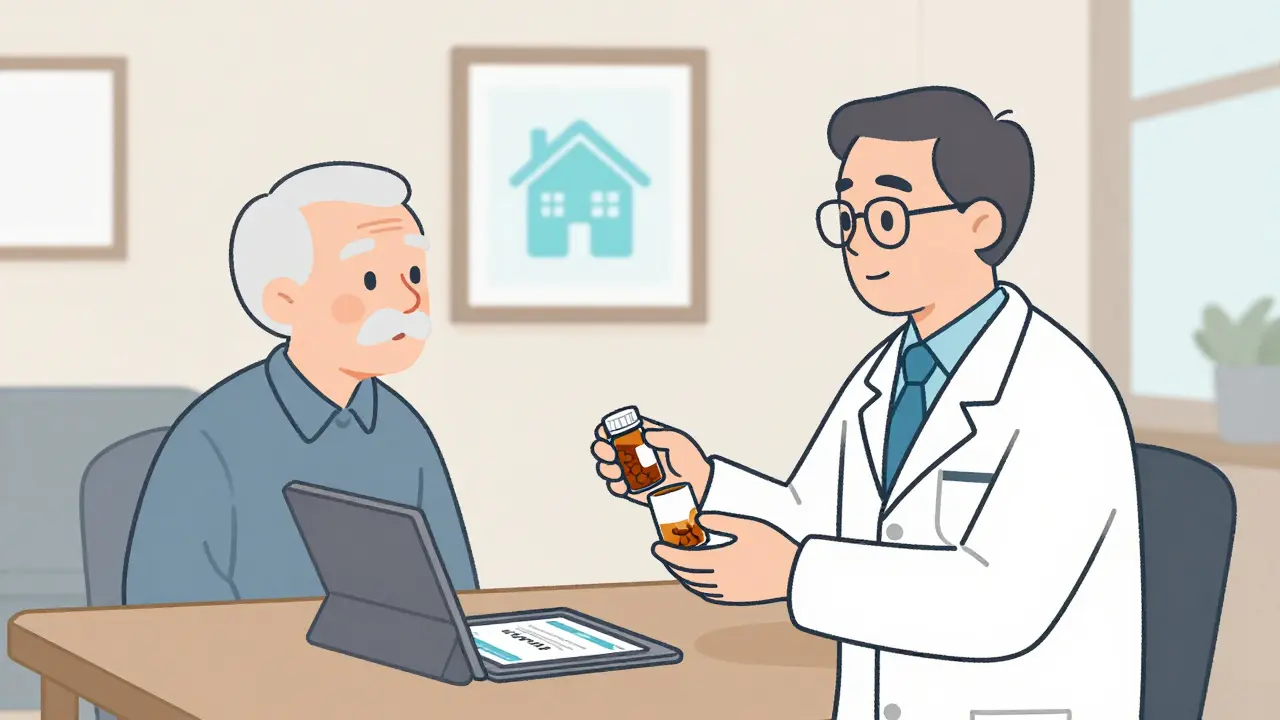
When your GP prescribes a branded drug like Crestor (rosuvastatin), the pharmacy doesn’t always give you that exact brand. Instead, they usually hand you a generic version-same active ingredient, same dose, same effect, but often half the price. That’s pharmaceutical substitution, and it’s been standard practice for years. But since October 1, 2025, the rules have tightened.Under Regulation 33 of the NHS (Pharmaceutical Services) Regulations 2013, pharmacists have always been allowed to swap branded medicines for generics unless the doctor wrote ‘dispense as written’ (DAW). Now, the 2025 reforms require pharmacies to hit a 90% generic substitution rate for eligible prescriptions. That’s up from 83% in early 2025. The goal? Save the NHS hundreds of millions annually. The Office for National Statistics estimates the pharmaceutical substitution market will grow by 8.3% each year through 2028, driven entirely by this policy.
But here’s the catch: not all substitutions are automatic. If you’re on a medicine where the brand matters-like certain epilepsy drugs, blood thinners, or biologics-your doctor must explicitly block substitution. Otherwise, you get the cheapest option. Most patients don’t even notice. But for some, especially those with chronic conditions, even small differences in inactive ingredients can cause issues. The British Pharmaceutical Industry survey found that 54% of community pharmacies are worried about safety risks under the new rules, especially with remote dispensing.
The Remote Pharmacy Revolution
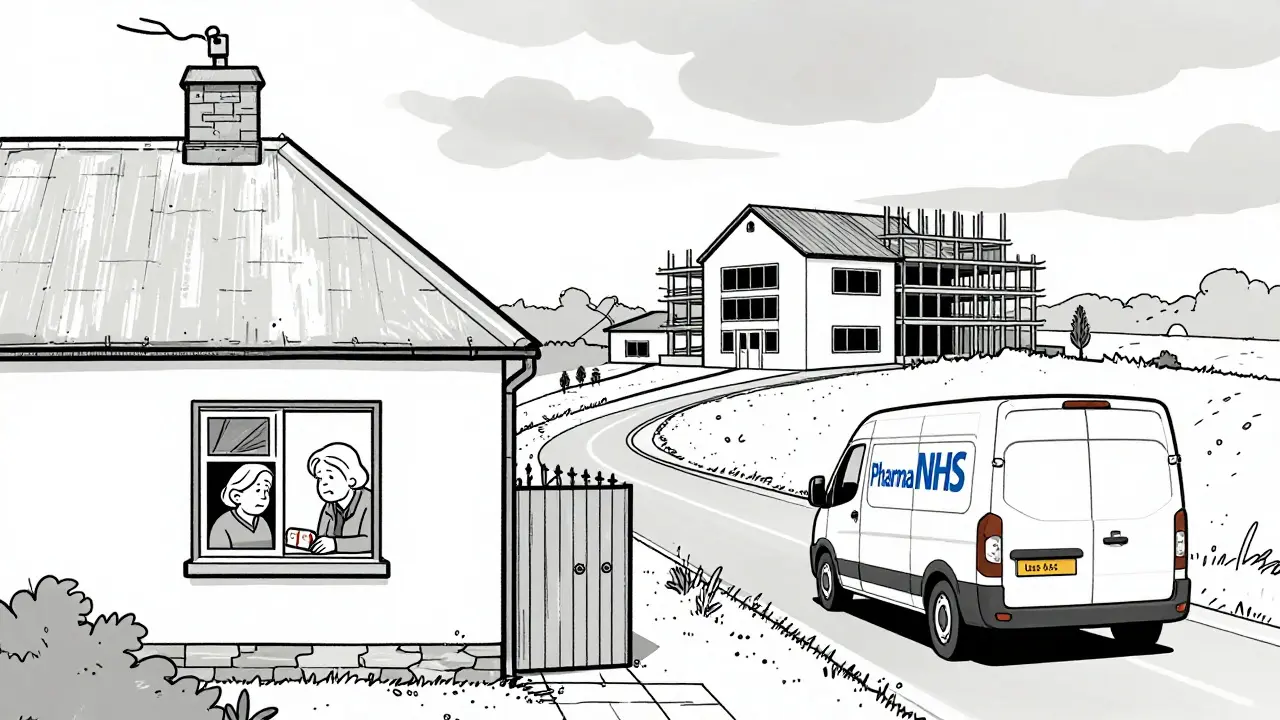
The biggest change in 2025? Pharmacies no longer need to be physical places.Under The Human Medicines (Amendment) Regulations 2025 (SI 2025 No. 636), all new and existing Digital Service Providers (DSPs) must deliver NHS pharmaceutical services remotely. That means no more walk-in counters. No more face-to-face consultations. No more handing you your pills in person. Instead, you order online or via an app, your prescription is processed digitally, and your medication is posted to you.
This isn’t science fiction. It’s law. And it’s already being rolled out. The DHSC says this will cut overheads, reduce foot traffic in pharmacies, and make services more scalable. But in practice? It’s creating real problems. A pilot in North West London showed a 12% rise in medication errors among elderly patients who struggled to use digital systems. One Reddit user from Manchester described how her 78-year-old father missed his monthly blood pressure tablets because he didn’t understand the app notification. He ended up in A&E.
Pharmacies are scrambling. The British Pharmaceutical Industry survey found that 54% of community pharmacies need between £75,000 and £120,000 to upgrade their systems. Many can’t afford it. Some are closing. Others are merging into regional hubs. The result? Rural areas are being left behind. In areas where internet access is patchy or where older people live alone, the shift to remote dispensing isn’t convenience-it’s a barrier to care.
Service Substitution: Moving Care Out of Hospitals
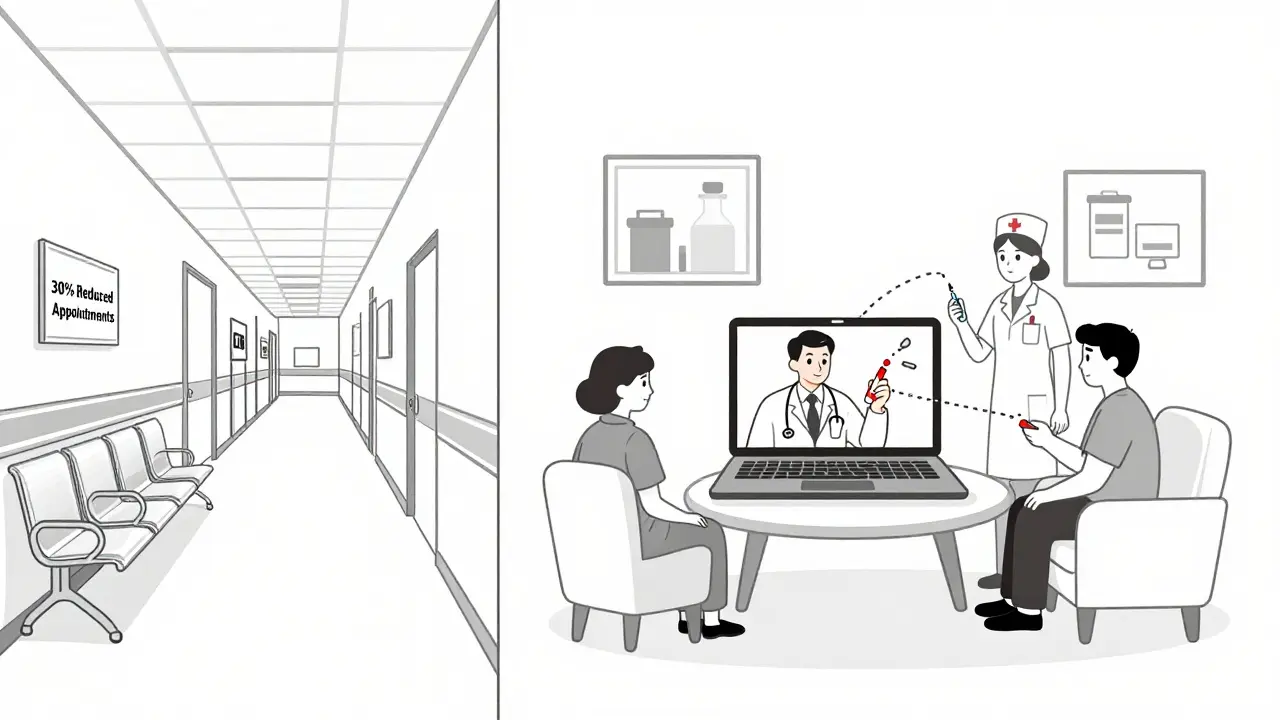
While pharmacy changes affect how you get your pills, service substitution is changing where you get your care.The government’s 2025 mandate to the NHS is blunt: move care ‘from hospital to community, sickness to prevention, and analogue to digital.’ That means hospital outpatient appointments, diagnostic scans, even some follow-ups for chronic conditions-are being replaced by community clinics, home visits, or virtual consultations.
The numbers are staggering. By 2027-28, the NHS aims to shift 30% of outpatient appointments out of hospitals. That’s 1.2 million fewer hospital visits a year, according to Professor Sir Chris Whitty. The savings? Billions. The promise? Better outcomes. The reality? It’s messy.
Take fracture clinics. A trial in several NHS trusts replaced in-person follow-ups with virtual check-ins. The result? A 40% drop in unnecessary visits. But 15% of elderly patients couldn’t join the video calls. No smartphone. No Wi-Fi. No tech support. For them, the substitution didn’t save time-it created a gap.
Community diagnostic hubs are being built across the country to replace hospital-based scans. The DHSC has allocated £650 million for this alone. These hubs offer X-rays, ultrasounds, and blood tests closer to home. Sounds great, right? But the NHS Confederation found that 68% of Integrated Care Boards (ICBs) don’t have enough staff to run them. In rural parts of Wales and northern England, there simply aren’t enough radiographers or nurses to staff these new centers.
Who’s Being Left Behind?
The biggest risk isn’t cost-it’s inequality.The King’s Fund warned in June 2025 that without urgent action, substitution policies could widen health gaps by 12-18% in deprived areas. Why? Because substitution works best when you have stable housing, good internet, digital literacy, and access to transport. It doesn’t work as well if you’re homeless, disabled, elderly, or living in a postcode with no bus service.
Take Greater Manchester. Early substitution programs there initially made things worse. People with complex needs-like those with dementia, mental illness, or multiple chronic conditions-were shuffled between services with no clear handoff. One patient went from hospital to a community nurse, then to a virtual GP, then to a pharmacy app. No one tracked her. She missed her insulin doses. She ended up in intensive care.
The Carr-Hill formula, set to launch in April 2026, is meant to fix this. It will redirect funding to areas with the highest need-where poverty, poor health, and low digital access overlap. But it’s too late for many. The NHS has already cut £1.8 billion from its 2025-26 budget to fund these substitutions. That money isn’t trickling down-it’s being spent on tech, not people.
The Workforce Crisis
You can’t substitute care without people to deliver it.The NHS needs 15,000 more community healthcare workers by 2030 to make this work. Right now, it’s short by 28,000. Nurses, paramedics, community pharmacists, health visitors-they’re all stretched thin. The NHS Staff Survey 2025 showed that 78% of hospital pharmacists fear medication safety is at risk under the new remote system. Meanwhile, 63% of community nurses support the shift. That divide isn’t just about opinion-it’s about workload.
Community nurses see the benefits: fewer hospital admissions, more time with patients, better continuity. Hospital pharmacists see the risks: prescriptions processed without context, no face-to-face checks, no way to spot a patient’s confusion or a drug interaction. The system is being restructured without fixing the staffing crisis first.
What This Means for You
If you’re on long-term medication, expect to get generics more often. If your doctor hasn’t told you otherwise, you’re probably already on one. Check your prescription label. If it says ‘generic,’ that’s normal. If you notice side effects, tell your pharmacist.If you’re elderly or have mobility issues, be prepared for your appointments to go online. If you don’t have a smartphone or reliable internet, ask your GP or local council for help. Some areas still offer phone consultations or home visits-but they’re becoming rarer.
And if you’re worried about your care being moved away from hospitals? You’re not alone. But the data shows this works-for some. Virtual fracture clinics cut follow-ups. Community diagnostic hubs reduced waiting times for scans. But for others, especially those without support, it’s creating new problems.
The NHS isn’t broken. It’s being rebuilt. And like any major construction project, the scaffolding is messy, the workers are tired, and the people who live here are just trying to stay safe.
Can my pharmacist change my prescription without telling me?
Yes, if your doctor hasn’t written ‘dispense as written’ (DAW) on the prescription. Pharmacists are legally allowed to substitute branded medicines with cheaper generics. You’ll usually get the same active ingredient, but sometimes the tablet shape or color changes. If you’re concerned, ask your pharmacist. You can also request the original brand, but you may need to pay extra if it’s not on the NHS list.
Are all prescriptions eligible for generic substitution?
No. Certain medicines-like epilepsy drugs, blood thinners, some biologics, and others where small differences matter-are excluded by law. Your doctor must write ‘DAW’ on the prescription to prevent substitution. If you’re unsure whether your medicine is affected, check with your GP or pharmacist. They can tell you if your drug is on the list of high-risk substitutions.
What if I can’t use the new remote pharmacy app?
You still have rights. If you’re elderly, disabled, or lack digital access, you can ask your local pharmacy or GP practice for alternative arrangements. Many still offer phone ordering, home delivery, or in-person collection. The NHS is required to make reasonable adjustments under the Equality Act 2010. If you’re being refused help, contact your local Integrated Care Board or Citizens Advice.
Why are hospital appointments being replaced with virtual ones?
The NHS is trying to reduce waiting lists and free up hospital space. Virtual appointments work well for routine check-ups, medication reviews, or follow-ups after surgery. But they’re not suitable for everyone. If you need physical exams, scans, or have trouble communicating over video, you can request an in-person appointment. Your GP or specialist should accommodate you if there’s a clinical need.
Will I pay more because of these changes?
For most people, no. Generic drugs are cheaper, and NHS prescriptions remain free for eligible groups. But if you’re no longer eligible for tax credits or travel expense exemptions (changed in April 2025), you might lose financial support. Also, if you need to pay for non-NHS services like private prescriptions or delivery fees from remote pharmacies, costs could rise. Check your eligibility on the NHS website or ask your local pharmacy.
Comments
8 Comments
Ethan Zeeb
The NHS is turning into a corporate efficiency dashboard with a side of human suffering. They’re cutting costs by automating care, but they forgot to account for the fact that people aren’t widgets. My aunt in Manchester got her blood thinner switched to a generic without warning. She had a mini-stroke. The pharmacy said ‘it’s the same active ingredient.’ Yeah, and so is rat poison and pepperoni-doesn’t mean you’d serve both at a dinner party.
They’re not fixing the system. They’re outsourcing its collapse to vulnerable people who can’t fight back. And now they want to pat themselves on the back for ‘reducing hospital foot traffic’ like that’s some kind of victory.
Stop pretending this is innovation. It’s austerity with a UX redesign.
Darren Torpey
Bro, this whole thing feels like someone took a perfectly good ambulance and turned it into a TikTok dance challenge. You’re telling me we’re replacing human pharmacists with apps because ‘it’s scalable’? Scalable like a house of cards in a hurricane.
I love that they call it ‘service substitution’ like we’re swapping out Netflix plans. ‘Hey, you used to get HD with live support? Now you get 480p and a chatbot named Barry who says ‘I’m sorry, I don’t understand.’
But hey-free generics? I’ll take it. Just… maybe don’t send my 80-year-old grandma a QR code to refill her insulin. Send her a damn person with a bag of pills and a cup of tea. That’s healthcare. Not a tech demo.
Lebogang kekana
Let me tell you something-this isn’t just about pills and apps. This is about dignity. In South Africa, we’ve seen what happens when governments cut corners on health and call it ‘efficiency.’ People die quietly. No headlines. No press conferences. Just silence.
Here in the UK, they’re doing the same thing but with PowerPoint slides and ‘digital transformation’ buzzwords. They think replacing a pharmacist with a drone delivery is progress. It’s not. It’s cowardice.
When your grandmother’s life depends on someone noticing she’s shaking, or her eyes are glazed, or she’s not answering her phone-that’s not a system failure. That’s a moral failure.
And they wonder why people are angry? I’m not angry. I’m devastated. And I’m not alone.
Jessica Chaloux
OMG I’m literally crying rn 😭
This is so heartbreaking. I had my grandma on my phone last week because she couldn’t figure out the app. She kept saying ‘I just want to see the nice lady at the counter.’ I couldn’t even… I just held her hand through the screen and cried. 😭💔
They took away her person. And now she thinks she’s being punished. Like she’s too old to be cared for.
Who approved this? Who looked into the eyes of someone who needs a hug and said ‘here’s a barcode’? 😭😭😭
Mariah Carle
There’s an existential irony here that’s almost poetic. We’ve outsourced the human element of care to algorithms because we’re too exhausted to do it ourselves. We don’t want to sit with someone in pain. We don’t want to learn their story. We don’t want to be present.
So we build apps. We push pills through the mail. We turn care into a transaction. And then we call it ‘innovation.’
But here’s the truth: care isn’t scalable. It’s sacred. And when you treat it like a KPI, you don’t just break the system-you break the soul of the society that built it.
We’re not losing pharmacists. We’re losing our capacity to be kind.
Justin Rodriguez
As a pharmacist who’s been in community practice for 14 years, I’ve seen this coming for a decade. The 90% generic target isn’t the problem-it’s the lack of support around it.
When a patient gets a new generic, I check their blood pressure, ask if they’ve had nausea, notice if they’re confused. That’s not just a job. It’s a safety net.
Now? I’m supposed to process 600 prescriptions a day through a digital portal while 30% of my patients can’t log in. I’m not a machine. And neither are they.
My team and I have been begging for more staff, better training, and backup for elderly patients. We’ve been ignored. So yes, I’m scared. Not because of generics. Because we’re being forced to become a bottleneck in a system that’s already collapsing.
Raman Kapri
Let’s be clear: this isn’t a crisis. It’s a rational cost-cutting measure. The NHS has been bleeding money for decades due to inefficiency, union overreach, and bureaucratic bloat. The substitution policies are a necessary correction, not a betrayal.
Yes, some elderly patients struggle with apps. So? They should have learned digital literacy years ago. Technology isn’t optional anymore. If you can’t adapt, you’re not a victim-you’re a relic.
And let’s not pretend that in-person consultations were somehow sacred. Most were 5-minute rushed affairs with a doctor scrolling through charts. Remote care is more consistent, better documented, and less prone to human error.
Stop romanticizing the past. The future is efficient. And if you can’t handle it, you’re part of the problem.
Megan Nayak
Oh wow. So the NHS is finally doing what every libertarian dreamt of: privatizing care through bureaucratic coercion. They didn’t need to sell pharmacies-they just made them irrelevant. Brilliant.
You think this is about efficiency? It’s about control. They don’t want you to have autonomy over your body. They want you to be a data point in a spreadsheet. A ‘risk category.’ A ‘cost center.’
And the real kicker? They’re using the language of compassion-‘community hubs,’ ‘remote support,’ ‘patient-centered care’-to mask a neoliberal dismantling of public health.
They didn’t fix the system. They made it invisible. And now, when people die alone in their homes because their insulin was delivered to the wrong address, no one will be held accountable. Just a polite email: ‘We’re sorry for your loss. Please complete our satisfaction survey.’
It’s not healthcare. It’s surveillance with a pill bottle.
Write a comment