

Have you ever looked at a bottle of generic medication and wondered if it’s actually working as well as the expensive brand-name version? You aren’t alone. A persistent myth circulates that because of the "80-125% rule," generic drugs can contain up to 25% less active ingredient than their brand counterparts. This idea causes genuine anxiety for patients managing chronic conditions. But here is the truth: that interpretation is completely wrong. The 80-125% rule has nothing to do with the amount of drug in the pill. It is a statistical measure of how your body absorbs that drug.
To understand why generics are safe and effective, we need to look past the marketing fears and dive into the science of bioequivalence. This concept is the backbone of modern pharmaceutical regulation, ensuring that when you switch from a brand name to a generic, you get the same therapeutic result. Let’s break down what this rule actually means, how it works, and why it protects your health.
What Is Bioequivalence?
Bioequivalence is a regulatory standard that proves two drug products have similar rates and extents of absorption in the body. When the U.S. Food and Drug Administration (FDA) approves a generic drug, they don't just check the chemical formula. They require proof that the generic behaves in your bloodstream just like the reference listed drug-the original brand-name product.
Think of it this way. If you drive from Bristol to London, it doesn't matter which car you take, as long as you arrive at the same time and cover the same distance. In pharmacology, the "distance" is the total amount of drug that reaches your system, and the "time" is how fast it gets there. Bioequivalence ensures that the generic car and the brand-name car get you to the same destination under the same conditions.
The FDA defines bioequivalence as the absence of a significant difference in the rate and extent to which the active ingredient becomes available at the site of drug action. This definition, codified in federal regulations since the Hatch-Waxman Act of 1984, shifted the focus from merely matching ingredients to matching biological performance.
Debunking the 80-125% Myth
The biggest misconception in pharmacy is the belief that the 80-125% range allows manufacturers to cut corners on dosage. People hear "80 to 125 percent" and assume a generic could have 80% of the drug or even 125%. That is not how the math works.
This rule applies to pharmacokinetic parameters, specifically metrics like AUC (Area Under the Curve) and Cmax (Maximum Concentration). These numbers measure exposure and speed of absorption, not the weight of the powder in the capsule. The 80-125% range is a confidence interval boundary used in statistical analysis. It does not mean the generic contains variable amounts of medicine. It means the statistical evidence must prove the absorption profiles are virtually identical.
Dr. Lawrence Yu, a former senior scientist at the FDA, has testified extensively on this point. He clarifies that bioequivalence is about the similarity of the drug's journey through the body, not a license for dosage variance. The active ingredient content in a generic pill is required to be within 5% of the labeled amount, regardless of the 80-125% bioequivalence calculation.
How the Math Actually Works
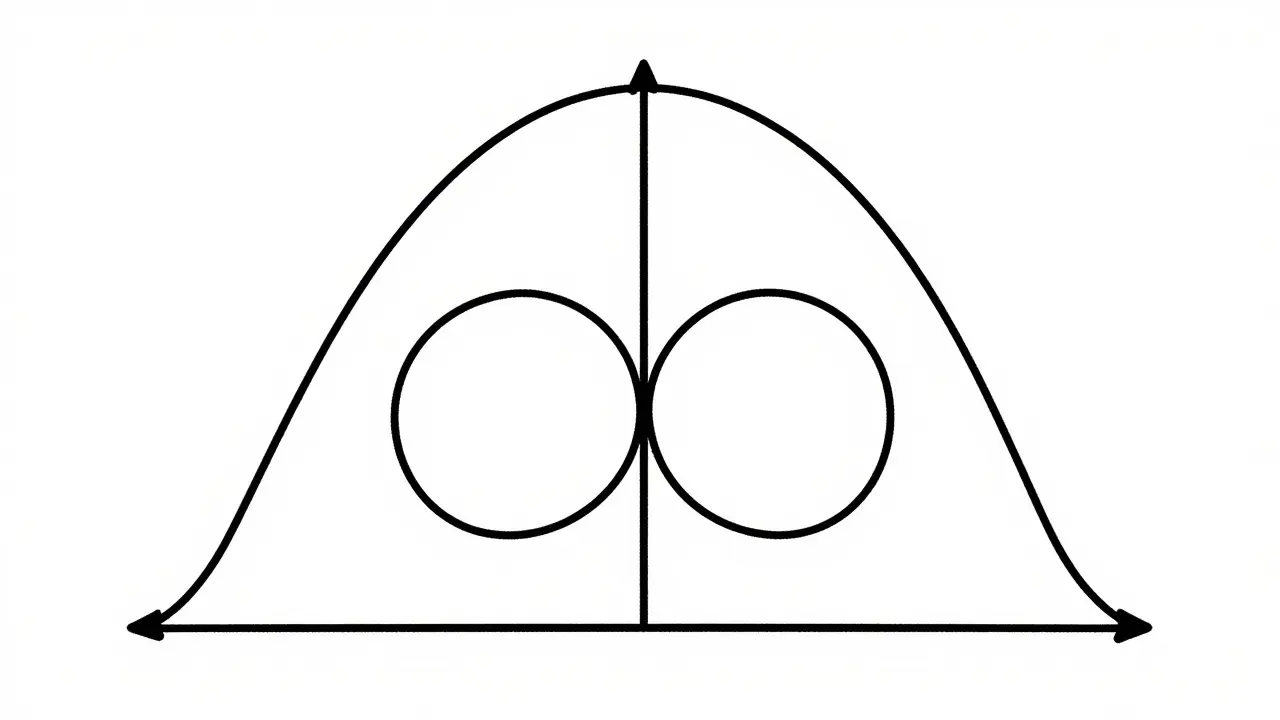
If you are curious about the numbers, the 80-125% rule comes from complex statistics involving logarithms. Drug absorption data is usually not normally distributed; it follows a log-normal distribution. To analyze this fairly, scientists transform the data using natural logarithms.
- The Log Transformation: The natural log of 0.80 is approximately -0.223. The natural log of 1.00 (100%) is 0. To keep the test symmetrical around the mean, the upper limit must be +0.223.
- The Upper Limit: If you reverse the log transformation for +0.223, you get roughly 1.25, or 125%.
- The Result: This creates an asymmetric range of 80-125% on the raw scale, which represents a symmetric ±20% margin on the log scale.
This mathematical approach ensures that the comparison is statistically valid. It accounts for the natural variability in how human bodies process drugs. Without this log-transformation, the statistical tests would be biased and unreliable.
The Role of Confidence Intervals
The 80-125% rule is not a simple pass/fail line for a single measurement. It relies on the 90% Confidence Interval (CI). Here is what that means for your safety.
In a bioequivalence study, researchers give healthy volunteers both the brand drug and the generic drug in a crossover design. They measure blood levels over time. Then, they calculate the ratio of the generic's absorption to the brand's absorption. The entire 90% confidence interval of this ratio must fall within the 80-125% window.
| Metric | What It Measures | Why It Matters |
|---|---|---|
| AUC (Area Under the Curve) | Total systemic exposure | Ensures you get the full dose over time |
| Cmax (Peak Concentration) | Rate of absorption | Ensures the drug works quickly enough |
| 90% Confidence Interval | Statistical certainty range | Proves the results are not due to chance |
Requiring the entire interval to fit inside 80-125% is much stricter than it sounds. For a generic to pass this test consistently, its true mean absorption usually needs to be within 95-105% of the brand name. According to an FDA analysis of over 2,000 studies, 98% of approved generics had point estimates within that tight 95-105% range. The 80-125% boundary is a safety net for statistical noise, not a target for manufacturing differences.
Exceptions: Narrow Therapeutic Index Drugs
While the 80-125% rule works for most medications, some drugs are more sensitive. These are called Narrow Therapeutic Index (NTI) drugs. Examples include warfarin (a blood thinner), levothyroxine (for thyroid issues), and certain anti-seizure medications.
For these drugs, a small change in absorption can lead to serious side effects or treatment failure. Recognizing this, the FDA tightened the standards. For NTI drugs, the bioequivalence range is often narrowed to 90-111%. This tighter constraint reflects the higher risk associated with these specific therapies. It shows that regulators adjust the rules based on clinical reality, rather than applying a one-size-fits-all approach blindly.

Real-World Evidence and Safety
Does this statistical theory hold up in real life? Yes. Extensive research supports the safety of generics. A landmark study published in JAMA Internal Medicine analyzed 2 million patient records. It found no significant difference in clinical outcomes between patients taking brand-name cardiovascular drugs and those taking generics.
The FDA’s Sentinel Initiative, which monitors safety data across 200 million patient records, has repeatedly confirmed these findings. Between 2015 and 2020, adverse event rates were virtually identical for brand and generic versions of 94% of evaluated products. This real-world data bridges the gap between laboratory statistics and patient health.
Furthermore, the economic impact is massive. Generics account for 90% of prescriptions in the U.S., saving the healthcare system hundreds of billions of dollars annually. This cost savings allows broader access to essential medicines without compromising efficacy.
Common Questions About Generic Absorption
Patients often have practical concerns beyond the math. Do fillers matter? Can I switch back and forth? Here are the facts.
- Inactive Ingredients: Generics may use different dyes or binders. However, these must be proven safe and cannot interfere with absorption. Allergies to specific dyes are rare but worth discussing with your pharmacist.
- Switching Brands: Because generics meet strict bioequivalence standards, switching between different generic manufacturers is generally safe. Your body will absorb the drug similarly.
- Complex Generics: Some drugs, like inhalers or topical creams, are harder to test. The FDA uses additional clinical studies for these "complex generics" to ensure equivalence, as blood levels alone might not tell the whole story.
Conclusion
The 80-125% rule is not a loophole. It is a robust statistical tool designed to account for human biological variability while ensuring therapeutic consistency. By requiring that the 90% confidence interval of absorption metrics falls within this range, regulators guarantee that generics perform identically to brand-name drugs in the vast majority of cases. Understanding this helps demystify generic medications and empowers you to trust the science behind your prescription.
Does the 80-125% rule mean generics have less drug in them?
No. The 80-125% rule refers to the statistical range of absorption rates (bioequivalence), not the amount of active ingredient in the pill. Generic pills must contain the exact same amount of active ingredient as the brand name, typically within a 5% variance of the label claim.
Are generic drugs as safe as brand-name drugs?
Yes. Extensive studies, including those by the FDA and JAMA, show that generic drugs have equivalent safety and efficacy profiles compared to brand-name drugs for the vast majority of medications.
What is a Narrow Therapeutic Index (NTI) drug?
NTI drugs are medications where small changes in blood concentration can lead to serious side effects or loss of efficacy. Examples include warfarin and levothyroxine. For these drugs, the FDA requires a tighter bioequivalence range (90-111%) to ensure safety.
Can I switch between different generic manufacturers?
Generally, yes. Since all approved generics must meet the same strict bioequivalence standards, switching between manufacturers should not affect the drug's performance. However, always consult your pharmacist if you have specific concerns.
Why is the range 80-125% instead of 90-110%?
The 80-125% range is derived from statistical log-transformation requirements. It represents a symmetric ±20% margin on a logarithmic scale, which is the correct way to analyze drug absorption data that follows a log-normal distribution. This method provides a more accurate assessment of bioequivalence than a linear percentage range.