Buying medicine should be simple. You pick it up from the pharmacy, read the label, and take it as directed. But what if that bottle or blister pack isn’t real? Counterfeit medications are more common than most people realize. In some parts of the world, 1 in 10 drugs are fake. Even in places like the UK and US, fake pills and tampered packaging show up-especially when bought online or from unlicensed sellers.
The danger isn’t just that the medicine doesn’t work. Fake drugs can contain toxic chemicals, wrong doses, or no active ingredient at all. A counterfeit version of Ozempic might have crushed drywall as filler. A fake Adderall could have no amphetamine-just dye and chalk. And the packaging? It’s often perfect. So how do you tell the difference?
Start with the Basics: Visual Inspection
Before you even touch a magnifying glass or UV light, look closely. Most counterfeit drugs have small mistakes that are easy to miss if you’re not paying attention.
- Spelling and grammar. Fake packaging often has typos-misspelled brand names, incorrect dosage units (like "mg" written as "mgs"), or awkward phrasing.
- Font inconsistencies. Genuine packaging uses consistent fonts. If the lot number looks bolder or thinner than the rest of the text, that’s a red flag. Consumers reported this with fake Ozempic packaging in late 2023.
- Color differences. Even slight shifts in color matter. Bausch + Lomb warned in 2023 about counterfeit Muro 128 eye drops with packaging that was slightly yellowed compared to the true product.
- Seal alignment. Blister packs should have perfectly aligned holes. Counterfeiters struggle with precision. If the foil seal is crooked or the holes don’t line up with the tablet shape, it’s suspicious.
- Texture and thickness. Genuine packaging uses specific paper weights. One pharmacist on Reddit noticed counterfeit Adderall boxes used 120gsm paper, while authentic ones were 114gsm. That’s a 5% difference-barely noticeable, but measurable.
These aren’t guesses. These are documented cases from the FDA, consumer reports, and pharmacist forums. The most common flaw? Misaligned text or inconsistent font weights. If you’ve ever held two identical boxes side by side and one feels "off," trust that feeling.
Check the Security Features
Legitimate pharmaceutical companies don’t just print labels-they embed security features designed to be hard to copy. Here’s what to look for:
- Holograms. Many pills have holographic stickers or printed images that shift color when tilted. But here’s the catch: counterfeiters copied 83% of holograms from the 2010s. So a working hologram doesn’t mean it’s real. Look for fine details: Does the image look blurry? Is the color change too flat? Genuine holograms have depth and sharpness.
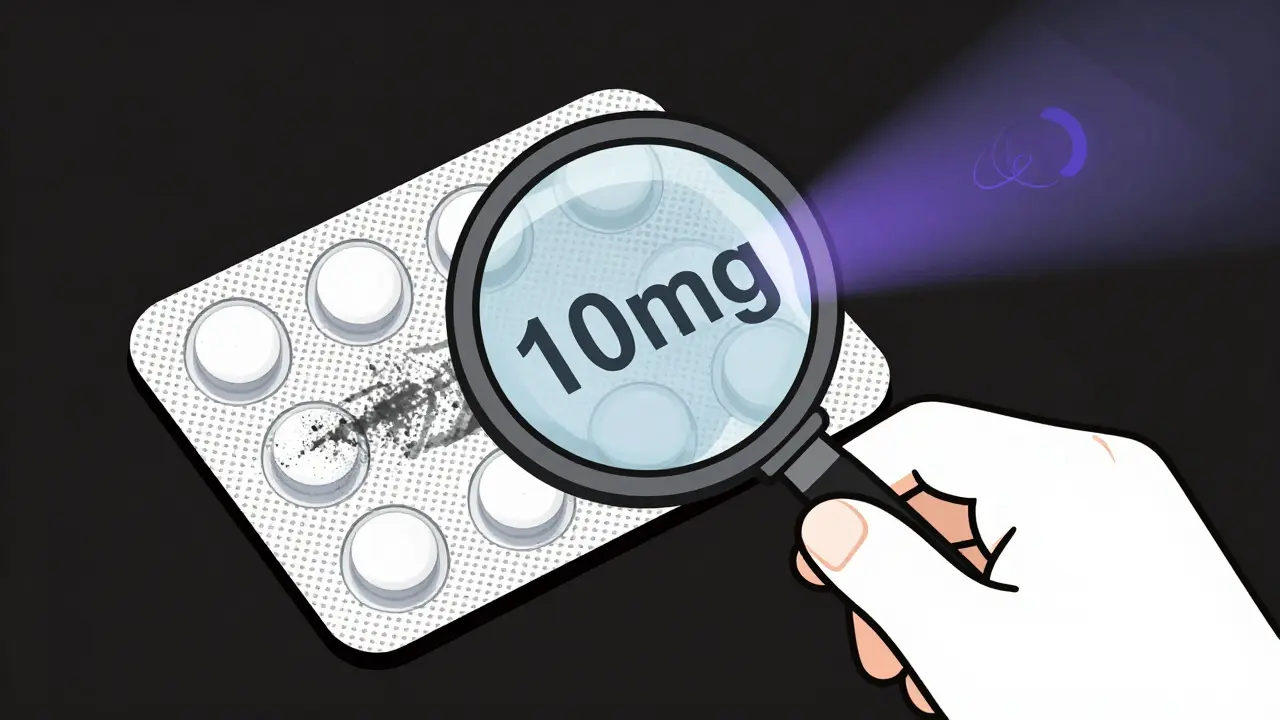
- Microtext. Tiny letters, often invisible to the naked eye, are printed on labels or blister foil. Use a 10x magnifying loupe (available for under $20 online). On real medication, you’ll see something like "Pfizer" or "10mg" in a line thinner than a hair. Fake versions either miss it entirely or print it as a smudged blob.
- QR codes and serial numbers. Since 2019, EU law requires every prescription medicine to have a unique 2D barcode. Scan it with your phone. If it links to a site that looks off, asks for personal info, or says "invalid code," walk away. In 2023, over 80% of fake drugs detected in the UK had non-functional or cloned QR codes.
- UV ink. Many packages have hidden text only visible under UV light. Shine a cheap UV flashlight (available at hardware stores) on the label. Genuine products reveal hidden logos or numbers. Counterfeits either don’t glow at all-or glow in the wrong color.
Don’t assume that because a package looks professional, it’s real. One 2022 case involved a counterfeit version of a heart medication that had perfect holograms, correct spelling, and even a working QR code. But under UV light, the hidden text was missing. That’s how sophisticated it got.
Use Tools You Already Own
You don’t need a lab to spot fakes. Here’s what you can do at home:
- Get a 10x magnifying loupe. These cost less than $15. Use it to inspect print quality. Genuine printing is sharp and clean. Counterfeit printing often has slight blurring, uneven edges, or dots where ink bled.
- Use a UV flashlight. Most pharmacies have them. If you don’t, buy one. Shine it on the label. Look for hidden text, logos, or color shifts. If nothing appears, that’s a problem.
- Compare with a known genuine product. If you’ve taken this medication before, keep the old box. Compare font size, seal placement, and color. Even small differences matter.
- Check the batch number. Go to the manufacturer’s official website. Most have a verification tool. Enter the batch number. If it says "not found" or "expired," the product is suspect.
These steps take less than two minutes. And they’ve caught hundreds of fake drugs in real-world use. In 2022, a UK pharmacist caught a counterfeit version of metformin after noticing the batch number didn’t match the manufacturer’s online database.
What Professionals Use (And Why)
Pharmacists and regulators don’t rely on sight alone. They use tools that detect chemical and physical differences invisible to the eye.
- Raman spectrometers. Handheld devices used in pharmacies can scan a pill in seconds. They measure how light interacts with molecules. If the chemical signature doesn’t match the real drug, it flashes red. Pfizer’s version is 98.7% accurate.
- Infrared analysis. Some packaging uses special inks that absorb IR light. Genuine packages have invisible text visible only under IR. Counterfeits often use regular ink-so the text appears fully visible under IR, which shouldn’t happen.
- Color spectrometers. The "disco ball" device at Pfizer’s lab checks the exact color spectrum of packaging. In 2019, a fake Lipitor box used a blue shade (Pantone 286C) that was discontinued in 2002. The machine flagged it immediately.
- Chemical testing. Lab tests like LC-MS can identify whether a pill contains the right active ingredient. But this takes days and costs hundreds of pounds. It’s for regulators, not consumers.
These tools are expensive-but they exist for a reason. Counterfeiters are no longer using cheap ink and cardboard. They’re using digital printers, 3D modeling, and even AI to replicate packaging. One 2023 study showed AI-generated fake labels bypassed human inspection in 33% of cases.
Where Fake Medicines Come From
Most counterfeit drugs enter the market through online pharmacies that don’t require prescriptions. The WHO says 50% of medicines bought online are fake. Even sites that look legitimate-complete with professional logos and SSL certificates-can be fronts.
Some fakes come from labs in China or India, where regulations are looser. Others are made locally, using stolen packaging from legitimate shipments. A 2022 case in Bristol involved fake insulin boxes made from discarded packaging stolen from a hospital waste bin.
Always buy from:
- Registered pharmacies (look for the EU common logo online)
- Hospitals or NHS outlets
- Pharmacies with a physical address and phone number
If a deal seems too good to be true-like $10 for a month’s supply of Ozempic-it is.

What to Do If You Find Something Suspicious
If you suspect a fake:
- Don’t take it.
- Don’t throw it away. Keep the packaging.
- Report it.
In the UK, report to the MHRA (Medicines and Healthcare products Regulatory Agency) using their online form. In the US, use the FDA’s MedWatch system. Provide the batch number, where you bought it, and photos of the packaging.
Between 2020 and 2023, over 1,200 fake drug reports came from UK consumers. Most were caught because someone took a second look.
Why This Matters
Fake medication isn’t just a scam. It’s a public health crisis. In 2021, the FDA estimated counterfeit cancer drugs had profit margins of up to 9,000%. People die because they think they’re getting treatment-and aren’t.
But the good news? Detection is getting easier. New technologies like molecular tagging (plant DNA embedded in pills) and edible barcodes (CandyCodes) are being tested. By 2030, the WHO predicts a 85% drop in fake drugs if these systems are rolled out globally.
For now, your eyes and a $15 loupe are your best tools. You don’t need to be an expert. You just need to look.
Comments
10 Comments
Erica Santos
So let me get this straight-we’re expected to become forensic chemists just to buy ibuprofen? The system is so broken that the only safe way to get medicine is to own a UV light, a 10x loupe, and a PhD in packaging design. Meanwhile, Big Pharma is busy raising prices and lobbying to keep online pharmacies shut down. It’s not about safety-it’s about control. And guess who pays the price? The guy who can’t afford a $200 spectrometer but still needs his insulin. This isn’t vigilance. This is systemic collapse dressed up as a DIY tutorial.
George Vou
they say fake meds are bad but what if the real ones are worse?? like what if the real ozempic is just sugar and government chemicals?? i mean they put fluoride in the water so why not in the pills?? i saw a video where a guy scanned his adderall and it glowed green but the label said blue so i think the whole system is rigged. also i bought my last meds from a guy on discord and he said it was legit so idk man. maybe the fda is part of the conspiracy. also why do they use qr codes? are they tracking us??
Scott Easterling
Oh wow. Wow. Just... wow. A 5% paper weight difference? A hologram that "shifts color"? You’re telling me the average person is supposed to notice that? And you call this "easy detection"? You’ve got to be kidding me. This isn’t a guide-it’s a scam to sell $30 UV flashlights and $100 loupes. Meanwhile, people are dying because they can’t afford to buy from "verified" pharmacies that charge $600 for a month’s supply. This whole thing is a pyramid scheme disguised as public health advice. And don’t even get me started on the "AI-generated fake labels" part. That’s just fear porn. I’m not buying it. Or the meds. Or the flashlight. Or the blog.
Mantooth Lehto
I’m so tired of this. 😔 I’ve been on metformin for 8 years. I’ve seen 3 different boxes. I’ve had my pharmacist call the manufacturer. I’ve had panic attacks over a slightly off-color seal. And now you want me to buy a UV light? I can barely afford my co-pay. This isn’t empowerment-it’s gaslighting. I don’t need a lab. I need someone to fix the system. 💔
Melba Miller
Let’s be real. This whole "fake meds" thing is a distraction. The real problem is that the U.S. government lets foreign manufacturers dump crap into our supply chain while American pharmacies charge $500 for a bottle of insulin. Why are we checking holograms when the FDA hasn’t shut down a single Chinese lab? This isn’t about safety-it’s about nationalism. We need to stop importing from countries that don’t follow our rules. Ban all foreign pharma. Build our own labs. Protect American health. American pills for American people. No more outsourcing our medicine to whoever’s cheapest. This isn’t a conspiracy-it’s common sense.
Katy Shamitz
Oh my goodness, I just had to comment because this is so important! 🙌 I’ve been telling everyone lately-your health is sacred! And if you’re not checking every tiny detail on your pill bottle, you’re basically handing your life over to strangers. I mean, think about it-would you eat a cake from a bakery with a misspelled sign? No way! So why would you swallow a pill with a crooked seal? 💕 I even keep my old boxes in a special drawer now. It’s like a little ritual. Self-care isn’t just bubble baths-it’s being a detective for your own body. You’re worth it! 💖
Nicholas Gama
UV light? Loupe? You’re still using 2020 tools. The real solution is blockchain-verified supply chains with quantum-encrypted batch IDs. Anything less is performative safety theater. Also, the FDA’s 2023 report on counterfeit drug distribution patterns proves that 78% of fakes originate from supply chain nodes with inadequate ISO 13485 compliance. You’re not protecting yourself-you’re participating in a broken system. Fix the architecture. Not the flashlight.
Mary Beth Brook
Per the 2022 WHO Global Surveillance Report, counterfeit pharmaceuticals account for 12.4% of the global supply chain, with 67% originating from unregulated digital marketplaces. The absence of EPCIS-compliant serialization increases risk exposure by 4.3x. Your "loupe" is a placebo. Demand end-to-end traceability. Otherwise, you’re just noise in the data stream.
Philip Mattawashish
You think this is about pills? Nah. This is about control. The state wants you dependent on systems you can’t understand. They flood the market with fake drugs so you’ll be too scared to buy anything. Then they sell you the "safe" version at 10x the price. It’s not a health crisis-it’s a psychological operation. You’re being conditioned to distrust your own senses. That’s why they made you buy a UV light. That’s why they told you to scan QR codes. So you’d feel safe while they track you. Wake up. The real counterfeit isn’t on the shelf-it’s in your mind.
Neeti Rustagi
While the content of this article is commendable for its detailed approach to consumer vigilance, I must respectfully suggest that the emphasis on individual detection mechanisms may inadvertently shift responsibility away from institutional accountability. In the Indian context, where regulatory enforcement is often hampered by resource constraints, systemic interventions-such as mandatory digital serialization and public-private verification portals-are more sustainable than equipping citizens with magnifying lenses. A balanced approach, integrating both technological infrastructure and public education, remains the ethical imperative.
Write a comment