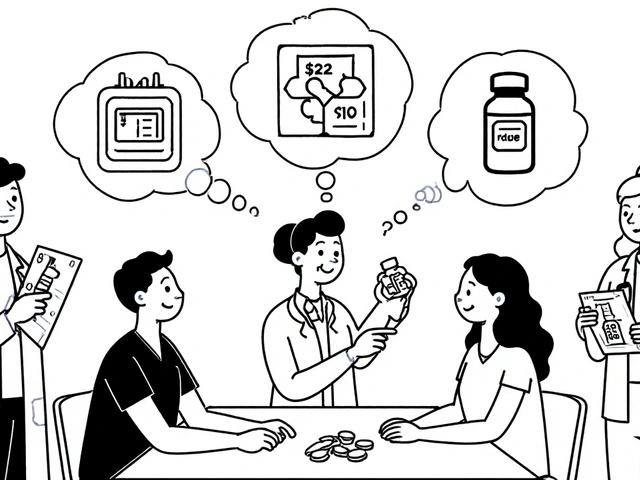

When a drug recall happens, time isn’t just money-it’s lives. A single contaminated pill or mislabeled vial can cause serious harm, especially if it’s still sitting on a shelf somewhere, unnoticed. That’s why verifying recall notices and matching them to the exact medication lots in your possession isn’t optional. It’s mandatory. And it’s not as simple as checking an email. The FDA, state boards, and hospitals have built a whole system around this because mistakes happen-and they cost lives.
Why Verification Isn’t Just a Formality
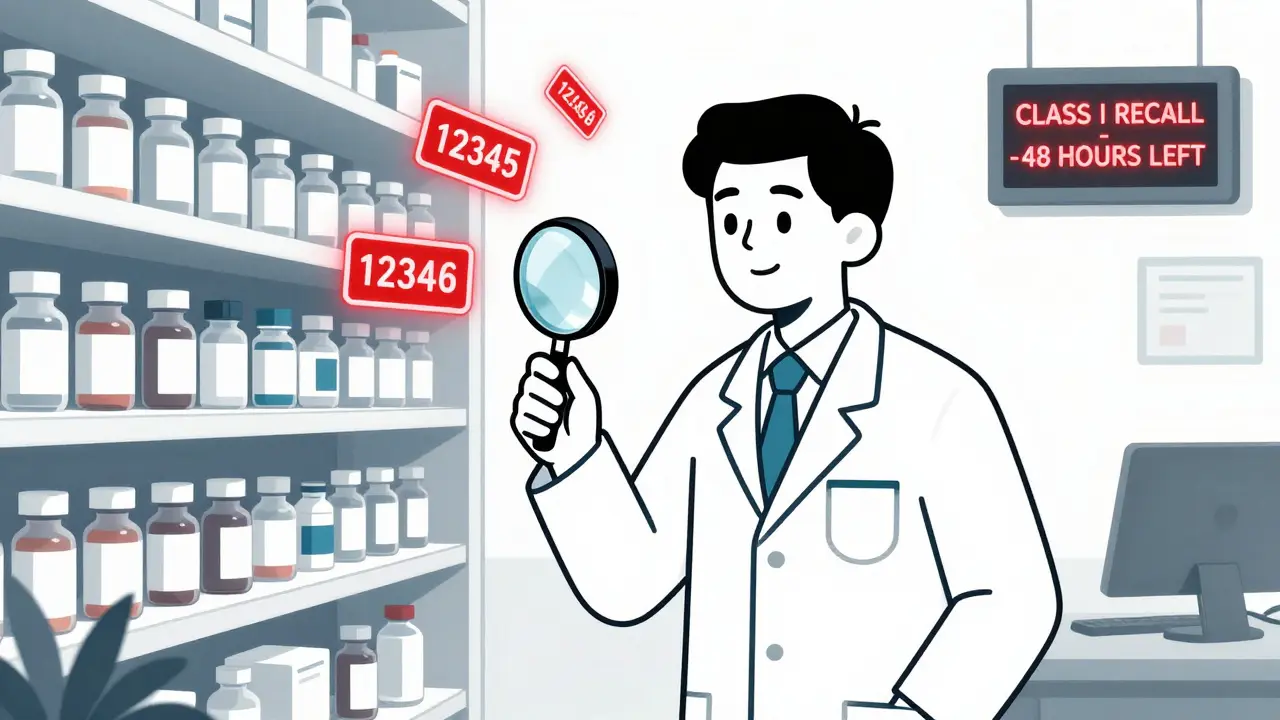
Every year, thousands of drug recalls are issued. In 2022 alone, the FDA reported 7,142 drug recalls. Most of these weren’t due to contamination; they were because of labeling errors, incorrect dosages, or manufacturing defects. The problem? Many of these recalled products never leave the shelves. Why? Because no one checked. The FDA classifies recalls into three levels:- Class I - Highest risk. Could cause serious injury or death. Must be acted on within 48 hours.
- Class II - Might cause temporary health problems or low risk of serious harm.
- Class III - Unlikely to cause harm, but violates FDA labeling or manufacturing rules.
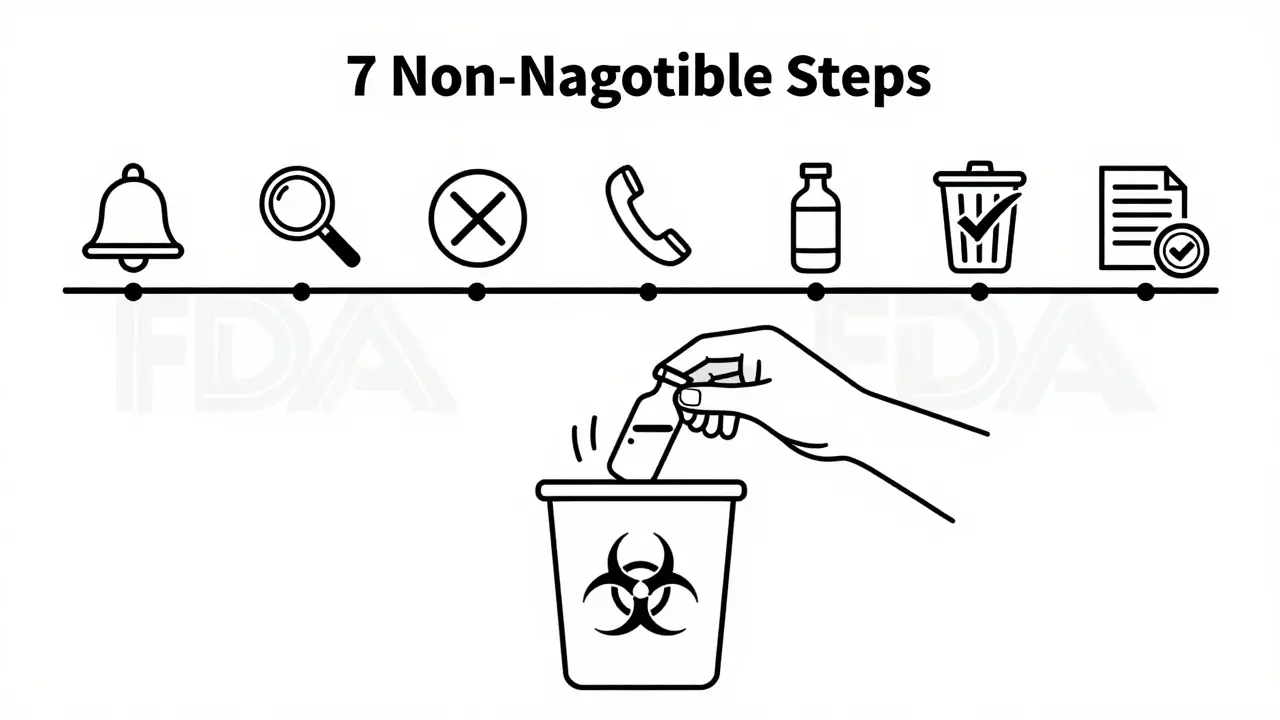
The Seven Steps Every Facility Must Follow
There’s no room for guesswork. The California State Board of Pharmacy and ASHP laid out seven non-negotiable steps for verification:- Get notices from multiple sources. Don’t wait for a letter in the mail. Sign up for FDA’s MedWatch alerts, email notifications from manufacturers, and automated systems like First Databank or Grayson’s RecallTrac. Relying on just one channel? You’re missing up to 37% of recalls, according to ISMP.
- Match exact product identifiers. You need the National Drug Code (NDC), lot number, expiration date, and packaging size. A mismatch in any one of these means you’re not done. FDA audits found 68% of facilities failed to check all four.
- Remove the product from patient care areas within 24 hours. Even if it’s sealed, unopened, or in an emergency kit, it’s still a risk. 41% of audit failures came from unopened stock.
- Identify affected patients. If the drug was dispensed to patients, you must contact them. For Class I recalls, you must confirm contact with 100% of direct recipients.
- Find alternatives. Don’t just pull the drug-replace it. Work with suppliers to get safe substitutes quickly.
- Return or destroy the recalled product. Follow your facility’s disposal protocol. Never just throw it in the trash.
- Document everything. Date, time, staff involved, quantities removed by lot number, patient notifications, and how you replaced the product. Joint Commission requires this. And they audit.
Manual vs. Automated: The Real Difference
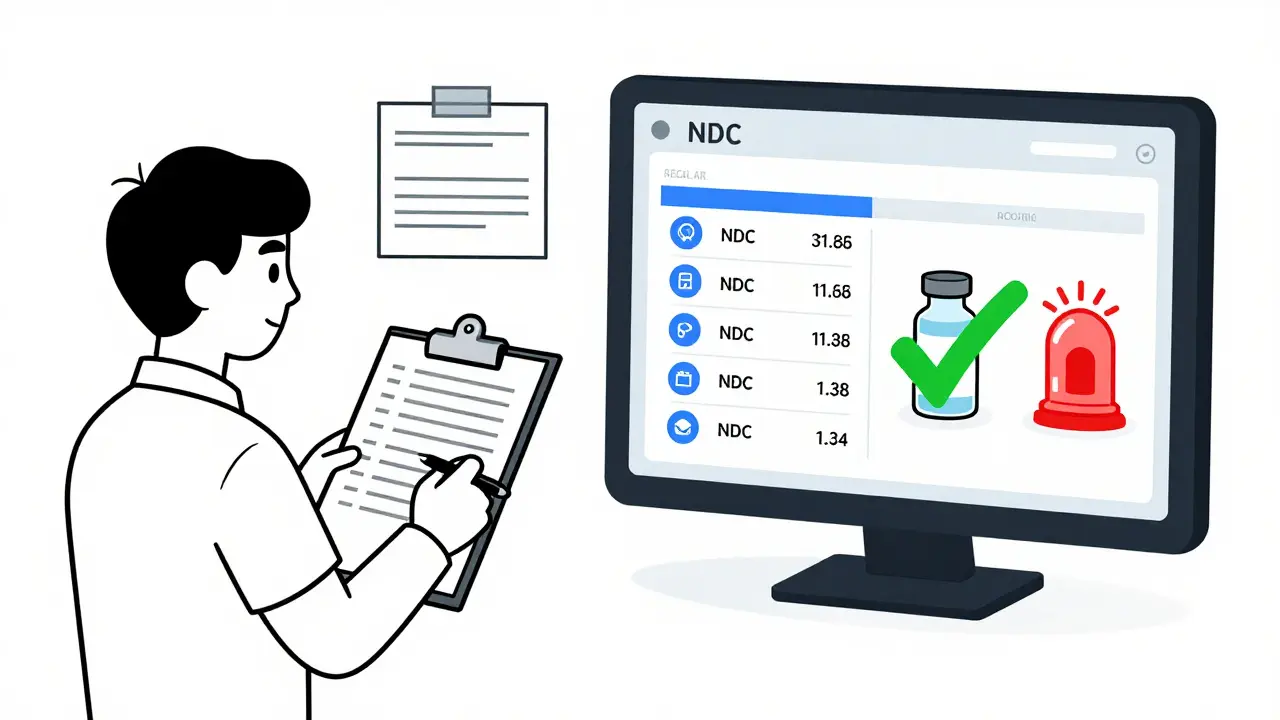
Some places still use paper lists, faxed notices, and spreadsheets. It’s slow. It’s error-prone.- Manual verification: Takes an average of 4.7 hours per recall. Error rate? 18.3%. That means nearly 1 in 5 times, someone misses a recalled lot.
- Automated systems: Cut that time to 1.2 hours. Error rate? Just 2.1%.
- A pharmacy management system running Windows Server 2016 or later
- Integration with your electronic health record (EHR)
- Regular updates to your product database
Common Mistakes That Put Patients at Risk
Here’s what goes wrong-and it’s not always obvious:- Not checking emergency kits. 41% of audit failures came from unopened supplies in crash carts or code blue boxes.
- Confusing similar lot numbers. One facility recalled “Lot 12345” but didn’t catch “Lot 12345A.” The FDA says 47% of recalls involve inconsistent numbering.
- Waiting for a single notification. One pharmacy got a recall notice via email but ignored a fax from the manufacturer. They missed 12 vials. A patient had a seizure.
- False positives. 63% of pharmacists report systems flagging products that weren’t actually recalled. That wastes time and breeds distrust in the system.
What You Need to Do Today
You don’t need a $10,000 system to get started. Here’s your action plan:- Build a recall playbook. Write down who does what. Who checks emails? Who calls patients? Who logs actions? 86% of top-performing facilities have one.
- Train your team. At least 2 hours of annual training is required by Joint Commission. Make it practical-walk through a real recall scenario.
- Use the FDA’s 7-point checklist. Print it. Post it. Use it every time.
- Set up multiple alert channels. Sign up for FDA MedWatch, manufacturer alerts, and at least one third-party service like First Databank.
- Check your emergency kits. Every month. Not just when there’s a recall.
The Future Is Automated-But You Can’t Wait
By 2027, the Drug Supply Chain Security Act will require all prescription drugs to be verified electronically. By 2026, 85% of verification will happen through integrated platforms. AI-powered lot matching is already being tested in 12 academic hospitals. But right now? You’re still responsible. And if you’re relying on manual checks, you’re one missed lot away from a tragedy. Don’t wait for a recall to happen. Prepare for it. Build your system. Train your team. Verify every lot. Because when it comes to medication safety, there’s no such thing as “probably.”What’s the fastest way to verify a drug recall?
The fastest way is through an automated system integrated with your pharmacy inventory. These systems cross-reference incoming recall alerts with your database in real time, flagging affected lots within seconds. TruMed’s AccuSite and Navitus’ Recall Management Platform, for example, reduce verification time from hours to under 2 minutes. But if you don’t have automation, the next best option is using FDA’s MedWatch portal combined with daily manual checks of your inventory against recall notices.
Do I need to check every single vial in my inventory?
Yes-if the recall affects a specific lot number, you must check every vial, bottle, or package with that lot number-even if it’s sealed, unopened, or stored in an emergency kit. The FDA found that 41% of violations came from unopened stock. Don’t assume it’s safe just because it hasn’t been used.
What if the recall notice doesn’t list the lot number clearly?
Contact the manufacturer or distributor immediately. The FDA requires them to provide accurate, detailed recall information. If they don’t, report them to the FDA’s MedWatch system. Also, cross-reference the product’s NDC and expiration date with your records. Sometimes, manufacturers issue recalls by NDC alone if the lot number format is unclear or inconsistent.
Can I rely on my pharmacy management system to catch all recalls?
No. Even the best systems can miss a recall if they’re not properly updated or if the manufacturer uses a different NDC format. Always verify recall notices against multiple sources. A 2023 study found that 37% of recalls were not detected by systems relying solely on manufacturer notifications. Use at least two independent sources: one automated, one manual.
What happens if I don’t verify a recall properly?
You could face serious consequences: patient harm, lawsuits, loss of licensure, or FDA fines up to $84,350 per violation. The Joint Commission can also downgrade your facility’s accreditation. In 2022, 68% of hospitals failed FDA audits on recall verification, and many were cited for incomplete documentation. Compliance isn’t optional-it’s part of your legal duty as a healthcare provider.
Are there free tools I can use to track recalls?
Yes. The FDA’s MedWatch portal is free and provides real-time recall alerts. You can also sign up for email notifications from drug manufacturers and subscribe to ASHP’s Recall Bulletin. While these won’t automate your inventory checks, they’re essential starting points. Combine them with daily manual checks of your inventory, and you’ll cover the basics.
How often should I train staff on recall procedures?
At least once a year, as required by the Joint Commission. But top-performing facilities do quarterly drills. Simulate a Class I recall: send out a fake alert, have staff locate the product, notify patients, and document the response. This builds muscle memory. Studies show facilities with regular drills complete verification 3.2 times faster than those without.
What’s the difference between NDC and lot number?
The National Drug Code (NDC) identifies the drug manufacturer, product, and package size. It’s always the same for a given product. The lot number is specific to the batch produced. Two bottles of the same drug can have the same NDC but different lot numbers. A recall targets a specific lot, not the NDC-so you need both to verify correctly.
Can a recall affect products I didn’t order directly from the manufacturer?
Yes. Many drugs are distributed through wholesalers or third-party suppliers. A recall issued by the manufacturer applies to every unit with the affected lot number-no matter who sold it to you. Always verify the lot number against your purchase records, not just the supplier’s name.
How do I know if a recall notice is legitimate?
Check the FDA’s official recall database at www.fda.gov/safety/recalls. Legitimate notices always include the FDA recall number, manufacturer name, product description, and NDC. Never act on a recall notice sent only via phone or unverified email. Always confirm through the FDA site or by calling the manufacturer directly using a number from their official website.
Comments
14 Comments
Marie Crick
This is insane. One missed lot and someone dies. We're not running a pharmacy, we're running a death trap if we're not vigilant.
Taylor Mead
I've seen this go sideways in rural clinics. They rely on one email. One. And then they wonder why the audit failed. It's not the tech-it's the culture.
Caleb Sciannella
The procedural rigor outlined here is not merely advisable-it is a non-negotiable pillar of pharmaceutical ethics. The FDA's classification system, while seemingly bureaucratic, exists because empirical data demonstrates that even minor deviations in verification protocols precipitate cascading failures in patient safety. The 4.7-hour manual verification window, with its 18.3% error rate, is statistically indefensible in an era where real-time data integration is not only feasible but cost-effective. Institutions that persist in analog methods are not merely inefficient-they are ethically negligent.
Jana Eiffel
The philosophical underpinning of this entire framework rests upon the principle of non-maleficence. Every vial, every lot number, every expiration date is not merely inventory-it is a covenant between the provider and the patient. To treat verification as an administrative chore is to commodify human life. The Joint Commission’s audit standards, while rigid, are a moral compass. Automation reduces error, yes-but only intentionality reduces harm.
Hariom Sharma
Bro, this is why we gotta get our clinics on automation. I work in a small clinic in Kerala and we just started using FDA MedWatch + daily manual check. Took us 2 weeks to set up, but now we’re way less stressed. No more panic when a recall drops. Just hit refresh and go. 🙌
Nina Catherine
i just started at a new pharmacy and they still use paper logs for recalls?? like… are we in 2005? i mean i get budget stuff but come on. i spent 3 hours yesterday cross-checking 3 vials bc the system said 'no match' but the fax said 'lot 12345A' and we missed it last time. 😭
Greg Scott
Man, I used to think this was overkill. Then a patient got the wrong insulin batch. We didn’t catch it. She ended up in the ICU. Now I check every. single. vial. Even the ones in the crash cart. No excuses.
Scott Dunne
This is why American healthcare is broken. You need seven steps, three systems, and a PhD to verify a pill? In Ireland, we just use the national database. It’s automated, centralized, and we don’t have to walk the shelves like we’re searching for buried treasure. This is bureaucratic overreach disguised as safety.
Chris Beeley
Let me be clear: this entire system is a performance art piece designed by consultants who’ve never held a vial in their hands. The FDA doesn’t care about your NDCs-they care about headlines. The real issue? Supply chain opacity. Why are we still relying on manufacturers to self-report? Why isn’t blockchain being mandated? Why are we still using fax machines in 2024? This isn’t safety-it’s theater. And you’re all just applauding the actors.
Arshdeep Singh
You people are missing the forest for the trees. The real problem isn't the recall system-it's that we treat medicine like a commodity. We don't train pharmacists like they're life-or-death professionals. We train them like customer service reps. And now we're surprised when mistakes happen? The solution isn't more software-it's respect. Pay them like they matter. Train them like their judgment saves lives. Everything else is just noise.
Maddi Barnes
Okay but let’s be real-how many of these 7 steps are actually followed? I’ve been in 3 hospitals and every single one had a 'recall playbook'… taped to the fridge next to the expired yogurt. 🤦♀️ And don’t get me started on emergency kits. I once found a recalled antibiotic in a code blue box… labeled 'DO NOT USE' in Sharpie. Someone had tried to fix it. With a marker. We’re not fixing systems. We’re just slapping duct tape on a sinking ship. 😅
John Cena
I really appreciate how thorough this is. I work in a small clinic and we’re just starting out with automation. The key is consistency-not perfection. Even if you only do 3 of these steps right, you’re already ahead of most places. Small wins matter.
Jonathan Rutter
You’re all missing the point. This isn’t about technology or procedure. It’s about power. The FDA doesn’t want you to verify recalls-they want you to be dependent on them. Every system you build, every alert you subscribe to, every audit you pass-it all makes you more compliant, more obedient, more controllable. They’re not protecting patients. They’re building a surveillance state under the guise of safety. You think you’re saving lives? You’re just training yourself to obey. And when the next recall comes, you’ll be the first one to hand over your inventory without question. Wake up.
Amrit N
lol i just checked our inventory and found 3 vials from a 2022 recall. we thought they were gone. turns out someone moved them to 'backup storage' and forgot. we’re getting the automated system next month. until then… i’m doing the manual check. no more excuses. 🤷♂️
Write a comment