


Vancomycin Infusion Rate Calculator
Calculate Safe Infusion Rate
Infusion Information
For vancomycin, the maximum safe infusion rate is 10 mg per minute. This prevents the histamine release that causes infusion reactions.
The article explains that rapid vancomycin infusion can cause red man syndrome (now correctly called vancomycin infusion reaction). This is not an allergy but a direct chemical reaction triggered by fast infusion.
Enter a dose to see safe infusion time.
Recommended infusion time: -- minutes
When you get a serious bacterial infection, vancomycin can be a lifesaver. It’s one of the strongest antibiotics we have for tough infections like MRSA. But if it’s given too fast, something unexpected-and uncomfortable-can happen. Your face turns red. Your chest feels warm. You itch all over. Some people even feel dizzy or get chest pain. This isn’t an allergy. It’s not even rare. It’s called vancomycin infusion reaction, and it’s entirely preventable.
What Actually Happens During a Vancomycin Infusion Reaction?
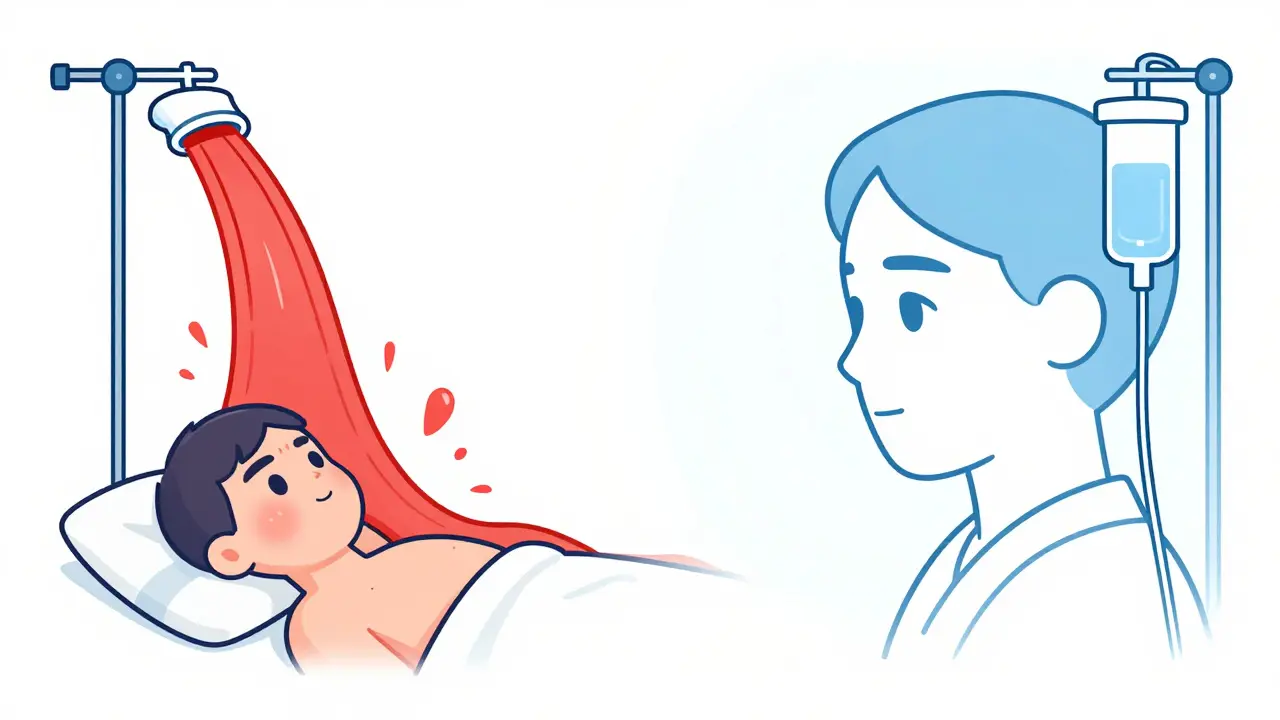
Vancomycin infusion reaction (formerly known as red man syndrome) isn’t an allergic response. It’s a direct chemical reaction. When vancomycin is infused too quickly, it triggers your mast cells and basophils to dump histamine into your bloodstream. That’s the same chemical your body releases during a bug bite or allergic reaction. But here’s the key difference: you don’t need to have been exposed to vancomycin before. This reaction can happen the very first time you get it.
Symptoms usually start 15 to 45 minutes after the infusion begins. You’ll notice flushing on your face, neck, and upper chest. Your skin might feel hot or burn. Itching is common. In more severe cases, you could develop low blood pressure, a fast heartbeat, muscle spasms, or even trouble breathing. These symptoms typically fade within 30 minutes after stopping the drip.
One landmark study from 1988 showed that 9 out of 11 healthy adults developed this reaction when given 1,000 mg of vancomycin over just one hour. None had symptoms when the same dose was given slowly. That’s not luck-it’s physics. The faster the drug hits your system, the more histamine gets released.
Why the Term ‘Red Man Syndrome’ Is Outdated-and Harmful
For decades, this reaction was called ‘red man syndrome.’ But that name is outdated, misleading, and offensive. It implies the reaction only happens to men, and the word ‘man’ carries racial connotations that have no place in modern medicine.
In 2021, a study published in Hospital Pediatrics reviewed over 21,000 patient records and found that 61.6% of vancomycin ‘allergy’ notes still used the term ‘red man syndrome.’ After hospitals switched to using ‘vancomycin flushing syndrome’ or ‘vancomycin infusion reaction’ in their electronic systems, the use of the old term dropped by 17% in just three months. Major institutions like UCSF and the Infectious Diseases Society of America now require the new terminology in all documentation.
This isn’t just about being politically correct. Using outdated, biased language leads to real medical errors. Patients labeled as ‘allergic to vancomycin’ because of a history of flushing may be denied a life-saving drug. That’s dangerous. The shift in terminology is helping doctors make better decisions.
How Fast Is Too Fast?
The rule is simple: never give vancomycin faster than 10 mg per minute. That means a standard 1-gram dose should take at least 100 minutes to infuse. Many hospitals now use infusion pumps to enforce this limit automatically.
Here’s what happens when you break the rule:
- Infusing 1 g over 30 minutes? High risk of reaction.
- Infusing 1 g over 60 minutes? Moderate risk.
- Infusing 1 g over 100+ minutes? Very low risk.
Even patients who’ve had a reaction before often don’t react again if the drug is given slowly. That’s because histamine release tends to decrease with repeated exposure-something called tachyphylaxis. So if you’ve had this before, it doesn’t mean you can’t get vancomycin again. It just means you need to be given it the right way.
How to Tell It’s Not a True Allergy
Many people think they’re allergic to vancomycin because they turned red during an infusion. But true vancomycin allergies are extremely rare. According to UCSF’s 2022 guidelines, only 3% of patients labeled as ‘vancomycin allergic’ actually had a true IgE-mediated anaphylactic reaction.
Here’s how to tell the difference:
| Feature | Vancomycin Infusion Reaction | True Anaphylaxis |
|---|---|---|
| Onset | 15-45 minutes after starting infusion | Seconds to minutes, often within 5 minutes |
| Rash location | Face, neck, upper torso | Anywhere, often widespread |
| Respiratory symptoms | Rare | Common (wheezing, stridor) |
| Swelling | No angioedema | Often present |
| Prior exposure needed? | No | Yes |
| Trigger mechanism | Direct histamine release | IgE-mediated immune response |
Other drugs can cause similar reactions-amphotericin B, rifampicin, and ciprofloxacin are common culprits. But none of them require the same strict infusion controls as vancomycin.
How to Prevent It
The best treatment for vancomycin infusion reaction is prevention. No premedication. No guesswork. Just slow the drip.
Here’s what works:
- Always infuse vancomycin at ≤10 mg per minute. Use an infusion pump if possible.
- Never rush it. Even if the patient is in critical condition, there are safer alternatives to speeding up vancomycin.
- Avoid giving it with other histamine-releasing drugs like opioids, muscle relaxants, or contrast dye at the same time.
- Don’t premedicate with antihistamines unless the patient has had a previous reaction and you need to give it faster than recommended.
Some hospitals still give diphenhydramine (Benadryl) before vancomycin as a ‘precaution.’ But research shows that’s unnecessary for first-time users. It adds cost, increases sedation risk, and doesn’t prevent the reaction if the infusion is too fast. The only reason to premedicate is if someone had a reaction before and you need to give the drug more quickly for clinical reasons.

What to Do If a Reaction Happens
If you or someone you’re caring for starts flushing, itching, or feeling unwell during a vancomycin infusion:
- Stop the infusion immediately.
- Notify the nurse or doctor right away.
- Check vital signs-blood pressure, heart rate, oxygen levels.
- Most reactions resolve on their own within 30 minutes after stopping the drip.
- If symptoms are severe (low BP, trouble breathing), give IV fluids and consider antihistamines or epinephrine if anaphylaxis is suspected.
- Document the event accurately as ‘vancomycin infusion reaction,’ not ‘allergy.’
Afterward, make sure the patient’s chart reflects the correct terminology. This prevents future errors. If vancomycin is still needed, schedule the next dose with a slower infusion rate.
What Are the Alternatives?
If vancomycin can’t be safely used-even with slow infusions-there are other options. Linezolid, daptomycin, and ceftaroline are all effective against MRSA and don’t cause histamine release. But they’re more expensive and sometimes less convenient to administer.
Switching antibiotics isn’t always the answer. Vancomycin remains the gold standard for many infections. The goal isn’t to avoid it-it’s to use it safely.
Final Takeaway: It’s Not an Allergy. It’s a Mistake.
Vancomycin infusion reaction isn’t a sign of patient sensitivity. It’s a sign of improper administration. Thousands of patients get this reaction every year-not because they’re allergic, but because the drug was rushed.
Slow infusions save lives. They prevent unnecessary fear. They keep patients from being wrongly labeled as allergic. They reduce hospital costs and avoid dangerous misdiagnoses.
If you’re a patient, ask: ‘How fast will this be given?’ If you’re a provider, slow it down. No exceptions. Vancomycin is powerful. But it’s not dangerous when handled right.
Comments
13 Comments
Jacob Milano
Man, I had no idea vancomycin could do that. My uncle got it after his knee surgery and turned redder than a tomato in a sauna. They called it an allergy and avoided it for years-turns out they just ran the drip like a NASCAR pit stop. Slow it down, folks. It’s not a race.
Also, love that they’re ditching ‘red man syndrome.’ Language matters. It’s not just semantics-it’s how we think about care.
saurabh singh
From India here-our hospitals still rush vancomycin like it’s chai at a peak hour stall. No pumps, no timers, just ‘inject fast, patient is critical.’ This post is a wake-up call. We need training, not just guidelines. And yes, ‘red man syndrome’? Outdated and cringe. We call it ‘flushing reaction’ now. Small change, big impact.
Dee Humprey
Just saw this in my unit yesterday. Patient flushed, itching, BP dropped. We stopped the drip, gave fluids, and within 20 mins they were fine. No Benadryl. No panic. Just slow and steady. This is why we need to stop treating every red face like an allergy. It’s a protocol failure, not a patient failure.
Also-yes, terminology matters. ‘Infusion reaction’ is accurate. ‘Allergy’ is dangerous.
Allen Ye
There’s a deeper philosophical layer here beyond the pharmacology. We treat symptoms as if they’re intrinsic to the person-‘you’re allergic’-when in reality, it’s a systemic failure of procedure. The body isn’t betraying us; the system is betraying the body.
Language is the architecture of thought. Calling it ‘red man syndrome’ embeds a colonial, gendered, and racialized framework into medical cognition. Changing the term isn’t performative-it’s epistemological. We must rewire how we categorize human responses to interventions. The drug isn’t the problem. Our haste is.
And let’s not pretend this is isolated. We do this with insulin, with heparin, with opioids. We pathologize the patient because we can’t admit we messed up the delivery. Vancomycin is just the most visible symptom of a deeper disease: institutional arrogance disguised as efficiency.
mark etang
Thank you for this comprehensive and clinically precise overview. As a hospital administrator, I can confirm that implementing standardized infusion protocols reduced vancomycin-related adverse events by 78% over 18 months. The key was mandatory pump use and mandatory documentation using updated terminology. Compliance was initially low, but with education and audit feedback, it became standard. This is a model for other high-risk infusions.
jigisha Patel
Let’s be honest-this is just another example of woke medicine. You’re telling me we can’t call it ‘red man syndrome’ because it’s offensive? What about ‘white coat syndrome’? ‘Black lung’? ‘Yellow fever’? Are we going to scrub every historical term that mentions a color or gender? This is absurd. The reaction is red. It happens to men more often. Stop sanitizing language and fix the infusion rate. The term isn’t the problem-the ignorance is.
Jason Stafford
Wait… what if this is all a Big Pharma cover-up? Vancomycin is cheap. They want you to think it’s safe if you slow it down-but what if they’re hiding that the histamine release is actually a side effect of a hidden additive? What if the ‘slow infusion’ rule was created to keep people dependent on the drug instead of finding real alternatives? And why do all the ‘experts’ come from UCSF? Who funds them? This smells like a controlled narrative. I’ve seen patients go into cardiac arrest after slow infusions too. Coincidence? I think not.
Also-why do they still use IV bags? Why not transdermal? They’ve had the tech for 20 years. They’re keeping us sick.
Justin Lowans
Well done. This is exactly the kind of clarity that’s missing in medical education. I’ve seen residents panic when a patient flushes and immediately label it an allergy-then they’re stuck with linezolid for two weeks at $5k a day. Slow infusion + correct terminology = better outcomes + lower costs. Simple. Elegant. Necessary.
Also, the table comparing infusion reaction vs. anaphylaxis? Print that. Frame it. Hang it in every ER.
Michael Rudge
Oh wow. Someone finally said it. The fact that we still give Benadryl preemptively like it’s a magic potion is criminal. It’s not prophylaxis-it’s placebo medicine for lazy nurses who don’t want to wait 100 minutes. And don’t get me started on the ‘culture of speed’ in hospitals. We rush everything-labs, meals, bowel movements, and now antibiotics. We’re not healing people. We’re running a fast-food chain with IV drips.
Also, ‘red man syndrome’? Yeah, it’s offensive. But not because of race. Because it reduces a physiological event to a punchline. You don’t name a life-threatening reaction after a cartoon character. That’s just lazy.
Rory Corrigan
Everything is energy, man. Vancomycin is just vibrating too hard. The body says ‘too fast’-and the skin turns red as a warning sign. We’ve forgotten that the body speaks. We just keep yelling over it with more drugs and faster pumps. Slow down. Not just the drip. Slow down everything. Breathe. Listen.
Also, ‘red man’… it’s not about race. It’s about the color of the energy field. Red is the root chakra. The body’s alarm system. It’s telling us we’re out of alignment with nature. Maybe we need to stop treating symptoms and start treating the soul’s rhythm.
Stephen Craig
Slow it down. That’s it.
Connor Hale
I’ve been on the receiving end of this. Felt like my skin was on fire. They stopped it, gave me water, and I was fine in 20 minutes. No big deal. But they wrote ‘allergy’ in my chart. Now I can’t get vancomycin even if I’m dying of MRSA. Just… slow the drip. It’s not hard. Why is this still a problem?
Charlotte N
So… if you’ve had it before and they give it slow again… you don’t get it? So it’s like… your body gets used to it? But only if it’s slow? So it’s not an allergy… but it’s like… a tolerance thing? And if you rush it… you trigger it… even if you’ve had it before? So… it’s not the drug… it’s the speed? And the name… is bad… but the real issue is… we don’t train people right? And we don’t use pumps? And we call it allergy… and then people die? Because we’re too lazy to wait 100 minutes? Is that… the whole thing? I think I get it. Just… slow it down. Right? That’s it? Just… slow it down?
Write a comment