


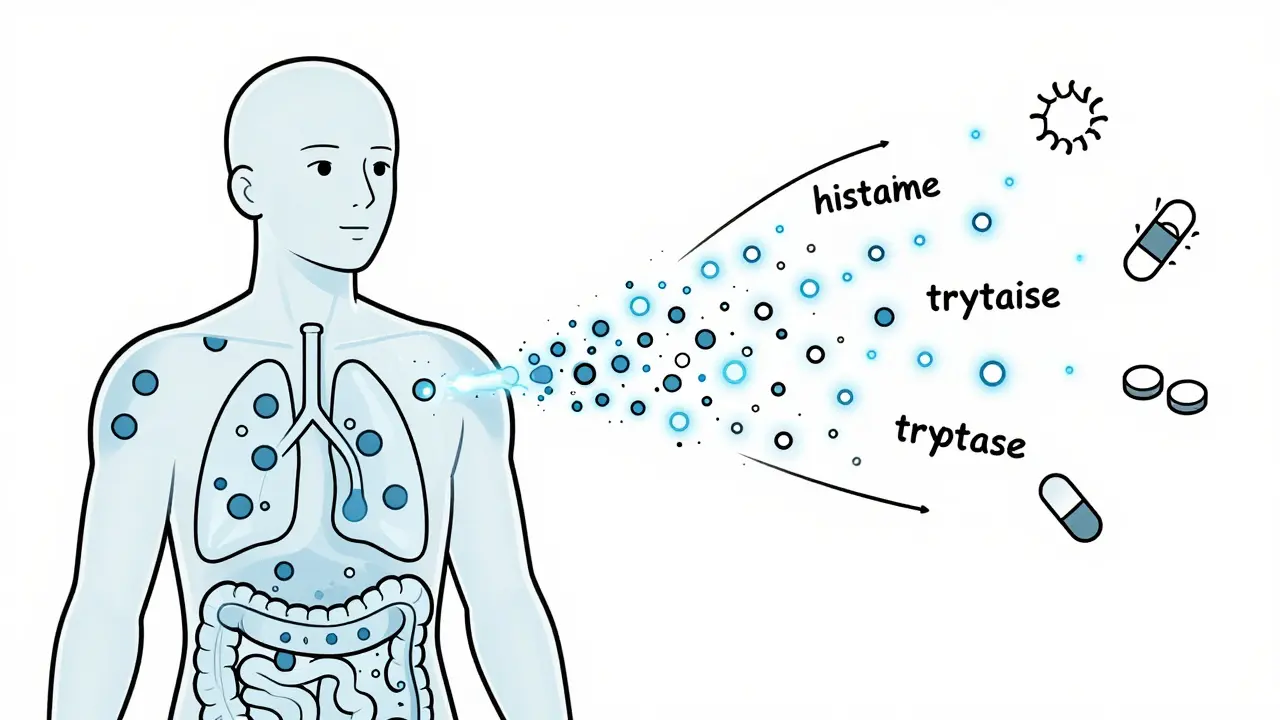
When your body reacts to something harmless-like pollen, a food, or even heat-it’s not always the allergen itself causing the problem. Often, it’s your own immune cells, specifically mast cells specialized immune cells that store and release chemical mediators in response to triggers, going into overdrive. These cells sit quietly in your skin, lungs, gut, and nasal passages, waiting for danger. But when they activate wrongly, they flood your body with chemicals that cause hives, stomach cramps, brain fog, low blood pressure, and even anaphylaxis. This isn’t just allergy-it’s Mast Cell Activation Syndrome (MCAS) a condition where mast cells release mediators inappropriately, leading to multi-system symptoms, and it’s more common than most doctors realize.
How Mast Cells Release Mediators-Fast and Furious
Mast cells are packed with chemical grenades. Inside their granules, they store histamine, tryptase, chymase, and heparin. When triggered, these are dumped out in under two minutes. Histamine alone can cause itching, swelling, and stomach pain. Tryptase, a protein enzyme, is so specific to mast cells that doctors use it as a blood test marker during suspected anaphylaxis.
But that’s just the start. Within minutes, mast cells start making new chemicals-prostaglandin D2, leukotriene C4, and platelet-activating factor. These worsen inflammation, tighten airways, and draw in other immune cells. Hours later, they pump out cytokines like IL-6 and TNF-alpha, which can keep your body in a constant state of low-grade alarm. This isn’t one big explosion. It’s a cascade: fast, then slow, then ongoing.
What sets off this chain? The most common trigger is IgE antibodies binding to the FcεRI receptor on mast cells-this causes about 70% of allergic reactions. But other triggers are just as important: stress, heat, certain foods, alcohol, NSAIDs like ibuprofen, and even bacterial fragments from your gut. A 2022 survey of over 1,200 MCAS patients found that 68% reacted to NSAIDs, 63% to alcohol, and 57% to heat. These aren’t random. They’re real, measurable triggers that bypass the IgE pathway entirely.
Why Antihistamines Often Fail
If you’ve been told to take antihistamines for your symptoms and they didn’t help much, you’re not alone. That’s because antihistamines only block histamine-the first wave. They do nothing for tryptase, prostaglandins, leukotrienes, or cytokines. A patient might feel better for an hour, then crash again as other mediators flood in. This is why many people with MCAS feel dismissed: their symptoms are real, but standard allergy treatments are too narrow.
Doctors often test for IgE levels or skin prick tests, but these miss non-IgE triggers. A 2019 study showed that 17% of people with chronic hives had MCAS, even though their IgE levels were normal. That’s why diagnosis can take 6 to 10 doctor visits over several years. Many are misdiagnosed with anxiety, IBS, or chronic fatigue syndrome. The real clue? Symptoms that change with triggers, improve with stabilizers, and involve multiple systems-skin, gut, brain, heart-all at once.
Mast Cell Stabilizers: The Quiet Heroes
Enter cromolyn sodium a mast cell stabilizer that prevents granule release by blocking calcium influx. First approved by the FDA in 1973 for asthma, it’s now used off-label for MCAS. It doesn’t calm inflammation. It doesn’t block histamine. It stops mast cells from releasing mediators in the first place.
How? It stabilizes the cell membrane, preventing calcium from rushing in. Calcium is the signal that tells the cell: “Open the granules.” No calcium, no explosion. Cromolyn works best when taken before exposure-like taking a shield before walking into a storm.
Another option is ketotifen a mast cell stabilizer with antihistamine properties, used at 1-4 mg twice daily for MCAS. It’s slightly more potent than cromolyn and crosses into the brain, which helps with brain fog. Studies show it reduces MCAS symptoms by 50-70% in many patients. But both drugs take time. Patients report feeling better after 4-8 weeks. One woman on MastAttack.org saw a 70% drop in anaphylactic episodes after eight weeks of 200 mg four times daily.

The Limits of Stabilizers
Here’s the hard truth: mast cell stabilizers don’t fix everything. They block degranulation-so they stop histamine, tryptase, and chymase. But they don’t stop cytokine production. Cytokines are made through different pathways, often triggered by stress or infection. That’s why some patients still flare even on high doses.
Also, they’re not fast. If you’re having an acute reaction, cromolyn won’t help. You need epinephrine for anaphylaxis. Stabilizers are for prevention, not rescue.
And side effects? About 35% of people on cromolyn get nausea or diarrhea. The liquid form tastes awful-patients rated it 2.1 out of 5 in a 2019 survey. Some kids need feeding tubes to take it. Still, for those who respond, it’s life-changing.
What Works Better? The New Frontiers
There’s growing hope beyond stabilizers. In 2023, the FDA approved avapritinib a targeted therapy for advanced systemic mastocytosis that inhibits the KIT D816V mutation, a genetic mutation found in 95% of systemic mastocytosis cases. It’s not for MCAS yet, but it’s proof that targeting mast cell biology works.
Next up? SYK kinase inhibitors. These block signals deep inside the mast cell, stopping both degranulation and cytokine release. In Phase II trials, they reduced mediator release by 75% at 100 mg daily. KIT-targeted drugs and mast cell-specific monoclonal antibodies are also in development. Experts believe these could hit 80-90% symptom control by 2030.
For now, though, stabilizers remain the most accessible tool. The global market for them is projected to hit $2.4 billion by 2030-not because they’re perfect, but because they’re the only widely available option that stops the root cause, not just one symptom.

Practical Steps for Managing MCAS
If you suspect MCAS, here’s what to do:
- Track triggers: Keep a log of symptoms after eating, stress, heat, or medication use. Use the “mast cell trigger wheel” from TMSforaCure.org as a guide.
- Try cromolyn sodium: Start at 100 mg four times daily, 30 minutes before meals. Increase slowly over 4-6 weeks. Avoid taking it with food-it needs an empty stomach.
- Test biomarkers: Ask for serum tryptase (baseline and during flare) and 24-hour urinary methylhistamine. A reduction of 30% or more on treatment suggests response.
- Avoid NSAIDs and alcohol: These are top triggers for 68% and 63% of patients.
- Find a specialist: The Mast Cell Disease Society lists 350 verified doctors as of 2023. Most general allergists aren’t trained in MCAS.
One patient in Bristol, UK, described her journey: “I was told it was anxiety. I lost three jobs. Then I tried cromolyn. Six weeks later, I could walk to the shop without collapsing. It didn’t cure me-but it gave me my life back.”
Why This Matters Now
MCAS is no longer a fringe diagnosis. Academic medical centers have jumped from 42% having dedicated mast cell clinics in 2015 to 78% in 2026. The European Academy of Allergy and Clinical Immunology published formal testing guidelines in 2020. And the American Academy of Allergy, Asthma & Immunology now accepts clinical diagnosis-even without perfect biomarkers.
What’s clear is this: mast cells aren’t just about allergies. They’re central to chronic inflammation, gut disorders, neurological symptoms, and unexplained fatigue. Stabilizers like cromolyn and ketotifen don’t cure MCAS. But they interrupt the cascade. And for many, that’s enough.
Can mast cell stabilizers cure MCAS?
No. Mast cell stabilizers like cromolyn sodium and ketotifen don’t cure MCAS. They prevent mast cells from releasing mediators, which reduces symptoms. They work best as a long-term preventive tool, not a cure. Some patients achieve near-complete symptom control, but others still need additional therapies like antihistamines, leukotriene inhibitors, or dietary changes.
How long does it take for cromolyn sodium to work?
Most patients notice improvement after 4 to 8 weeks of consistent use. Some report partial relief as early as 2 weeks, but full effects usually take longer. This is because cromolyn doesn’t block existing mediators-it stops future releases. The body needs time to clear accumulated inflammation and reset its response patterns.
Why do some people with MCAS not respond to stabilizers?
Not all mast cell activation comes from degranulation. Stabilizers mainly block calcium-driven granule release, but cytokines and other mediators can be produced through alternative pathways, like stress-induced signaling or genetic mutations (e.g., KIT D816V). Patients with these pathways dominant may need additional drugs like biologics or kinase inhibitors.
Are there natural alternatives to mast cell stabilizers?
Some people use low-histamine diets, quercetin, or vitamin C to reduce mast cell triggers. These may help mildly by stabilizing membranes or acting as weak antihistamines, but they are not replacements for FDA-approved stabilizers like cromolyn or ketotifen. There’s no clinical evidence they prevent anaphylaxis or stop cytokine storms.
Can stress trigger mast cell activation?
Yes. Stress activates the nervous system, which releases neuropeptides like substance P that directly trigger mast cells. A 2022 survey found 52% of MCAS patients reported stress as a major trigger. This is why managing stress-through pacing, mindfulness, or therapy-is a critical part of treatment, even alongside medication.
Comments
12 Comments
Pat Fur
It’s wild how much we’ve overlooked mast cells. I used to think allergies were just histamine and antihistamines. Turns out, it’s like your body’s alarm system got hacked and now it’s screaming at cats and sunshine.
Reading this felt like someone finally put words to the chaos I’ve lived with for years. Not anxiety. Not IBS. Just overactive cells doing their job way too hard.
Elaine Parra
This is why American medicine is broken. You wait years for a diagnosis because doctors don’t want to admit they don’t know shit. We’re drowning in data but still treating symptoms like they’re separate problems. MCAS isn’t a niche condition-it’s the tip of the iceberg. And nobody’s willing to dive deep enough to fix it.
Natasha Rodríguez Lara
I love how this breaks down the cascade-it’s not one explosion, it’s a chain reaction. That’s so important for people to understand. I’ve seen friends give up on cromolyn because they didn’t feel better right away. But if you think of it like retraining your immune system’s reflexes… it makes sense it takes time.
Also, the stress connection? Huge. I didn’t realize my panic attacks were literally triggering mast cells until I started tracking. Mind-body stuff isn’t woo. It’s biology.
peter vencken
so cromolyn is like a bouncer for mast cells? keeps em from throwing the party?
also i tried ketotifen and yeah it helped with brain fog but the drowsiness was wild. took me 3 weeks to stop napping at 3pm. worth it tho.
ps: the liquid tastes like regret and salt
Chris Farley
Why are we giving people hope with these stabilizers when the real solution is fixing the broken immune system? You can’t just block one part of biology and call it a day. This is like putting duct tape on a leaking dam. We need to address root causes-not just manage symptoms with drugs that taste like ass.
Darlene Gomez
Thank you for writing this. Seriously. I’ve been telling my doctor for years that antihistamines don’t fix everything. She said I was overthinking. Then I found this article and printed it out. She actually listened after that.
Started cromolyn 6 weeks ago. First time in 8 years I walked to the grocery store without needing to sit down. Not cured. But I can breathe. That’s enough.
Jacob Hessler
so u mean to say i cant have beer or ibuprofen? bro thats my whole life. why do u hate fun? also i dont believe in this mast cell thing. sounds like new age bs to me. my grandma lived to 92 and drank whiskey every day.
Amber Gray
OMG YES. I’ve been telling people for years that heat triggers me. Like… I walk outside on a 75° day and suddenly my throat closes? Not anxiety. Not asthma. It’s my damn mast cells. 🤯
Also cromolyn tastes like a sad sock dipped in vinegar. But I’ll take it. Anytime I can go to the park without collapsing, I’m in.
Danielle Arnold
Wow. Another ‘I have a rare disease’ post. Can we please stop making up new illnesses so people can feel special? Maybe you just need to stop eating gluten and do yoga.
James Moreau
I really appreciate how this article acknowledges both the science and the human side. I work in a clinic and see patients get dismissed daily. The part about 6–10 doctor visits before diagnosis? That’s heartbreaking. We need more providers trained in this.
Also, the trigger wheel? Genius. I’m printing it for my next patient.
Seth Eugenne
Just wanted to say I’m so glad this exists. I’ve been on ketotifen for 10 weeks. My brain fog lifted around week 6. I can finally read a book without falling asleep. I didn’t know how much I’d missed that.
Also… I cry every time I read stories like the one from Bristol. Not because I’m sad. Because I finally feel seen.
Brandon Shatley
so wait so if i stop stress i stop the symptoms? sounds easy but its not. i work 60 hours a week. also i tried cromolyn and got diarrhea for a week. worth it? idk. but i still drink coffee. dont judge me.
Write a comment