
Drug Reaction Type Identifier
Select the characteristics of your medication experience below to identify the reaction type.
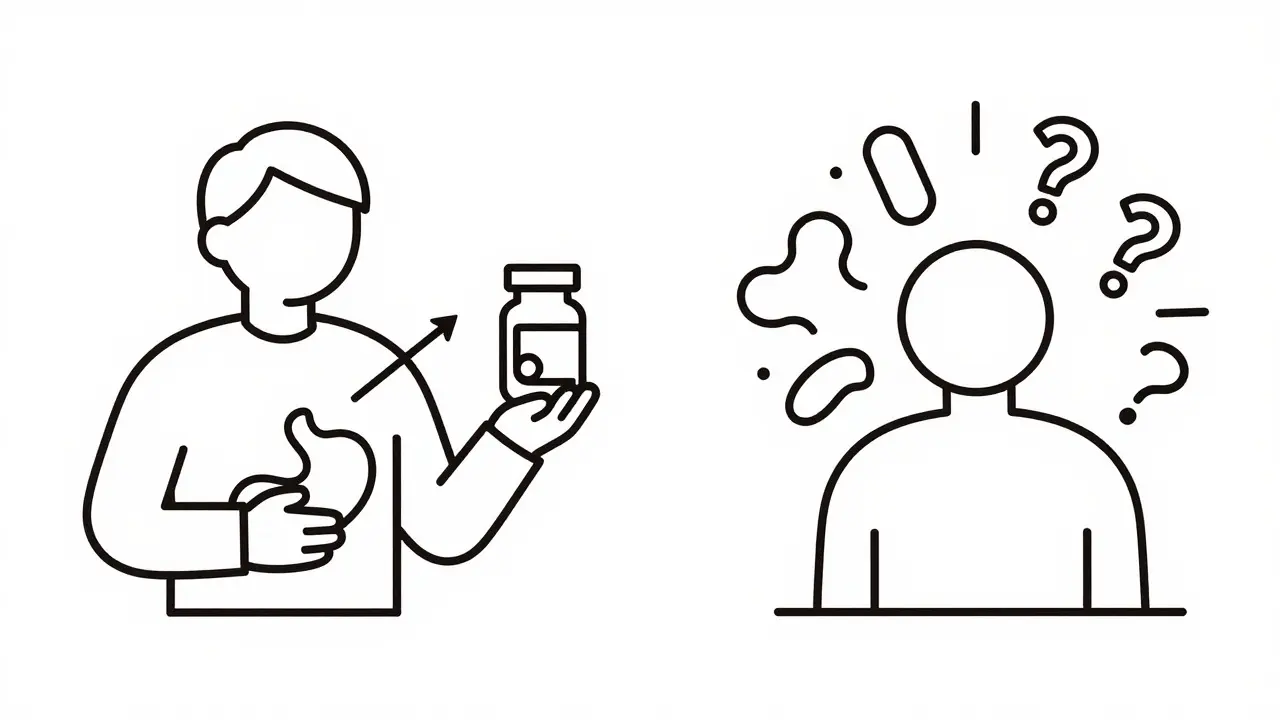
Imagine taking a painkiller for a headache and getting a stomach ache instead. Or worse, imagine taking an antibiotic for a simple infection and developing a life-threatening rash. Both are side effects, but they are fundamentally different beasts. One is a known risk you can manage; the other is a genetic lottery ticket you might not even know you bought.
Understanding the difference between predictable and unpredictable side effects isn't just academic trivia. It’s the key to staying safe while managing your health. Most people think all bad reactions to medicine are random accidents. They aren’t. In fact, about 75% to 80% of adverse drug reactions (ADRs) follow a clear, logical pattern. The remaining 20% to 25% are the wild cards that keep doctors on their toes.
The Logic Behind Predictable Side Effects (Type A)
Predictable side effects, clinically known as Type A reactions, are essentially exaggerated versions of what the drug is supposed to do. If a medication lowers your blood pressure, a predictable side effect might be making your blood pressure drop *too* low, causing dizziness or fainting. If it slows down digestion to treat diarrhea, constipation becomes the likely trade-off.
These reactions are dose-dependent. This means there is a direct line between how much medicine you take and how severe the side effect gets. Take more ibuprofen? Higher chance of stomach irritation. Take less? The risk drops significantly. Because these reactions stem from the drug's primary mechanism of action, they are well-documented in medical literature and package inserts.
- Mechanism: Direct extension of the drug’s therapeutic effect.
- Dose Relationship: High correlation. More drug equals higher risk.
- Preventability: Highly preventable through dose adjustment or monitoring.
- Mortality Rate: Generally low because they are recognized early.
A classic example is gastrointestinal bleeding from nonsteroidal anti-inflammatory drugs (NSAIDs) like aspirin or naproxen. These drugs work by blocking prostaglandins, chemicals that cause pain and inflammation. However, prostaglandins also protect the lining of your stomach. When you block them to stop pain, you inadvertently remove the stomach’s defense shield. Studies show this risk jumps from 1-2% at standard doses to 10-15% at high doses. It’s not magic; it’s chemistry.
The Wild Cards: Unpredictable Side Effects (Type B)
Now, let’s talk about the scary stuff. Type B reactions, or unpredictable side effects, have nothing to do with the drug’s intended function. You could take the exact same dose of a medication as your neighbor, who has no issues, and end up in the hospital with a severe skin reaction. Why? Because your body reacts differently due to genetics, immune system quirks, or unknown biological factors.
These reactions are not dose-dependent. Taking half the pill doesn’t necessarily lower the risk if you are genetically predisposed to react badly to it. They are rare-occurring in only 1 to 2 patients per 100 hospital admissions-but they account for a disproportionate number of serious injuries and deaths. While Type A reactions make up the bulk of complaints, Type B reactions are responsible for 15% to 20% of serious ADR hospitalizations.
| Feature | Type A (Predictable) | Type B (Unpredictable) |
|---|---|---|
| Frequency | Common (75-80% of ADRs) | Rare (20-25% of ADRs) |
| Dose Dependency | Yes (Higher dose = Higher risk) | No (Occurs regardless of dose) |
| Mechanism | Known pharmacological action | Idiosyncratic or allergic response |
| Reversibility | High (95% reversible) | Low to Moderate (60% reversible) |
| Example | Sedation from opioids | Anaphylaxis from penicillin |
Think of Type B reactions like food allergies. Most people eat peanuts without issue. For others, a single nut triggers a systemic collapse. With drugs, this might look like Stevens-Johnson syndrome, a severe condition where the skin blisters and peels off, triggered by medications like sulfonamides or carbamazepine. In some cases, such as with the drug abacavir used for HIV, we now know specific genetic markers (like HLA-B*5701) predict this reaction, allowing doctors to screen patients before prescribing. But for many other drugs, the trigger remains a mystery until it happens.
Beyond A and B: The Full Spectrum of Risk
While Type A and Type B cover the vast majority of cases, medical professionals use a broader framework (Types C through F) to categorize other nuances of drug safety. Knowing these helps you understand why a side effect might appear months after starting treatment or only when you stop taking it.
- Type C (Chronic): These occur after long-term use. Think adrenal suppression from using corticosteroids for years. Your body stops producing its own cortisol because the drug is doing the job, leaving you vulnerable if you stop abruptly.
- Type D (Delayed): Effects that show up long after exposure. Teratogenicity (birth defects) is the most critical example here, where a drug taken during pregnancy affects the fetus months later.
- Type E (Withdrawal): Symptoms that emerge when you stop the drug. Rebound hypertension or opioid withdrawal fit here. The drug itself didn’t cause the harm directly; the absence of it did.
- Type F (Failure): Unexpected failure of therapy. This often happens due to drug interactions. For instance, grapefruit juice can interfere with enzymes that break down certain statins, leading to toxic levels in the blood or, conversely, rendering the drug ineffective.
Why This Distinction Matters for Your Health
You might wonder, "So what? I just want to feel better." The distinction matters because it changes how you should behave as a patient. For Type A reactions, the strategy is monitoring and management. If you’re on blood thinners, you expect potential bruising or bleeding. You watch for it. You adjust your diet. You get regular blood tests. It’s a partnership with your doctor to keep the benefit greater than the risk.
For Type B reactions, the strategy is vigilance and education. Since you can’t always predict them, you need to know the red flags. Does the drug carry a warning for liver damage? Skin rashes? Severe allergic reactions? If you experience a new, unexplained symptom shortly after starting a medication, don’t assume it’s "just part of healing" or "stress." It could be an idiosyncratic reaction that needs immediate attention.
The economic impact underscores the severity. The U.S. healthcare system spends roughly $30 billion annually on managing adverse drug reactions. While Type A reactions cost more in total dollars due to their frequency, Type B reactions drive up costs per case due to intensive care needs, long hospital stays, and lifelong disability in severe cases. Preventing one severe Type B reaction can save tens of thousands of dollars and, more importantly, a life.
The Future of Prediction: Genetics and AI
We are moving into an era where "unpredictable" might soon become a misnomer. Pharmacogenomics-the study of how genes affect a person’s response to drugs-is rapidly changing the landscape. Tests for genes like CYP2C9 and VKORC1 are now used to tailor warfarin dosing, reducing the risk of both bleeding (Type A) and clotting (therapy failure).
Artificial intelligence is also stepping in. Systems trained on millions of electronic health records are beginning to spot patterns humans miss. While current AI models predict Type A reactions with nearly 90% accuracy, they still struggle with Type B reactions, hovering around 47% accuracy. This gap highlights the complexity of human biology. However, initiatives like the NIH’s "All of Us" research program are identifying new genetic links every year, slowly closing the net on these hidden risks.
Until then, the best tool you have is open communication. Tell your doctor about every supplement, over-the-counter medication, and herbal remedy you take. Share your family history of drug reactions. And never hesitate to ask, "What are the common side effects, and what are the rare ones I should watch out for?" Knowledge is the first line of defense in drug safety.
Are all side effects listed on a drug label predictable?
Most side effects listed on a label are Type A (predictable) because they are observed in clinical trials and linked to the drug's mechanism. However, labels also include warnings for severe Type B (unpredictable) reactions if they have been reported post-marketing, even if they are rare. The presence of a warning does not mean it will happen to you, but it indicates a known risk profile.
Can I reduce my risk of unpredictable side effects?
You cannot eliminate the risk entirely since it is often genetic, but you can mitigate it. Inform your doctor of any past drug allergies or unusual reactions. Ask if pharmacogenomic testing is available for your prescribed medication. Additionally, starting with a low dose and titrating up slowly can help identify mild reactions before they become severe, though this does not prevent true idiosyncratic reactions.
What should I do if I suspect a side effect?
Do not stop taking essential medications without consulting your doctor, as sudden cessation can cause withdrawal symptoms (Type E). Instead, contact your healthcare provider immediately. Describe the symptom, when it started relative to taking the dose, and its severity. For signs of severe allergic reaction (difficulty breathing, swelling of the face/throat), seek emergency care immediately.
Why are Type B reactions more dangerous than Type A?
Type B reactions are often immune-mediated or metabolic errors that can progress rapidly and severely, such as organ failure or widespread skin necrosis. Because they are not dose-dependent, stopping the drug may not reverse the damage quickly. They also tend to be unexpected, leading to delays in diagnosis and treatment compared to predictable side effects which clinicians monitor for proactively.
How common are adverse drug reactions in hospitals?
Adverse drug reactions are surprisingly common. Data suggests they occur in approximately 5 to 10 out of every 100 hospital admissions. While most are manageable Type A reactions, they remain a leading cause of hospital-acquired injuries. This high rate emphasizes the importance of careful medication reconciliation upon admission.