


Antibiotic Risk & Stewardship Impact Calculator
Patient Scenario
Impact Analysis
Relative C. Diff Infection Risk
Enter details to see risk
You’ve been sick for three days. Your throat hurts, you have a cough, and you feel exhausted. You walk into your doctor’s office, and within minutes, they hand you a prescription for antibiotics. It feels like the right move. But what if that medicine isn’t just unnecessary-it’s actually making you sicker?
This scenario plays out millions of times every year. We treat antibiotics like a cure-all, but they are precise tools, not magic bullets. When used incorrectly, they don’t just fail to help; they cause real harm. This is where antibiotic stewardship comes in. It is a coordinated effort to improve how antibiotics are prescribed by clinicians and used by patients to ensure optimal outcomes. The goal isn't just to save money or fight resistance (though those matter). It is about protecting you from severe, sometimes life-threatening side effects caused by taking the wrong drug, at the wrong time, for too long.
The Hidden Cost of "Just in Case" Prescriptions
We often think of antibiotic side effects as mild stomach upset or a rash. While those happen, the real danger lies deeper. Antibiotics are non-selective killers. They can’t tell the difference between the bacteria causing your infection and the trillions of "good" bacteria living in your gut, on your skin, and in your mouth.
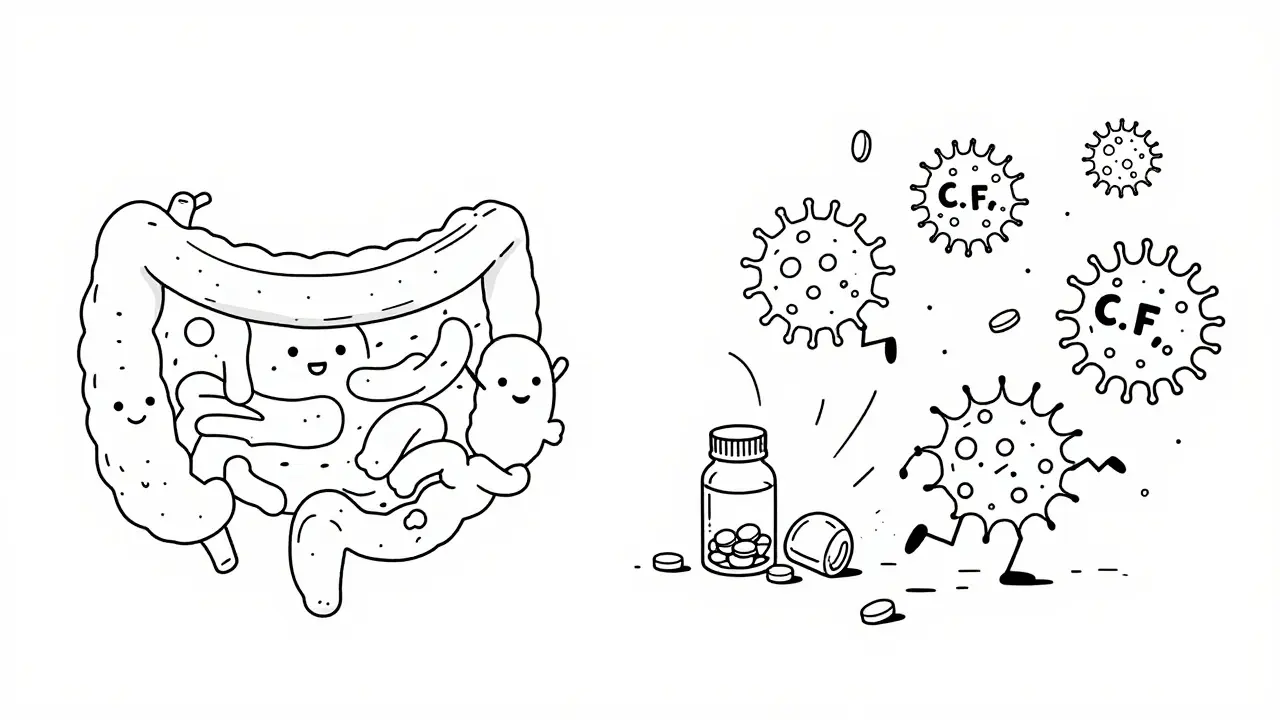
When you wipe out these beneficial microbes, you create a vacuum. Nature abhors a vacuum, so dangerous pathogens rush in to fill it. The most notorious example is Clostridioides difficile (often called C. diff). This bacterium causes severe, recurrent diarrhea and colitis. In fact, inappropriate antibiotic use increases your risk of getting a C. diff infection by 7 to 10 times compared to appropriate use. For elderly patients or those with weakened immune systems, this isn’t just uncomfortable-it can be fatal.
Beyond C. diff, broad-spectrum antibiotics (the "shotgun" approach that kills many types of bacteria) are linked to other serious issues:
- Allergic reactions: Unnecessary exposure increases the likelihood of developing new allergies.
- Kidney damage: Certain antibiotics, like vancomycin, can stress kidney function if used when not strictly needed.
- Tendon rupture: Fluoroquinolones carry a black-box warning for tendon damage, yet they are frequently overprescribed for minor infections.
The Centers for Disease Control and Prevention (CDC) estimates that at least 30% of antibiotics prescribed in outpatient settings and 20% in hospitals are unnecessary or inappropriate. That means nearly one in five prescriptions carries an unneeded risk profile.
What Is Antibiotic Stewardship Really?
If you’ve heard the term "stewardship," you might imagine a group of doctors sitting in a room judging other doctors’ prescriptions. It’s not quite that simple, and it’s certainly not punitive. Stewardship is a clinical support system.
Formally, organizations like the Infectious Diseases Society of America (IDSA) define it as "coordinated interventions designed to improve and measure the appropriate use of antibiotic agents." In plain English, it boils down to a mantra used in intensive care units since the early 2000s: Right drug, right dose, right duration, right route.
Stewardship programs typically involve a team-usually an infectious disease physician and a specialized pharmacist-who review cases. They don’t stop treatment; they optimize it. Their job is to ask four critical questions:
- Should we start antibiotics at all? Is this viral (like a cold) or bacterial?
- Which antibiotic is best? Do we need a narrow-spectrum drug that targets only the specific bug, or a broad-spectrum one?
- What is the correct dose and route? Can this be given orally instead of intravenously? Is the dose adjusted for the patient’s kidney function?
- How long should we continue? Do we really need 14 days, or will 5 days do the job without increasing relapse risk?
By answering these questions systematically, stewardship teams reduce the total amount of antibiotic exposure a patient receives, directly lowering the chance of side effects.
How Stewardship Protects You: The Data
Skeptics might argue that second-guessing a prescribing doctor delays care. However, the data shows the opposite. Stewardship improves patient safety while maintaining clinical effectiveness.
| Metric | Reduction/Achievement | Source Context |
|---|---|---|
| C. difficile Infections | 25-30% reduction | Pew Charitable Trusts / Hospital Studies |
| Adverse Drug Events | 21.5% reduction | IDSA/SHEA Guidelines Review |
| Inappropriate Prescribing | 15-30% reduction | CDC Core Elements Framework |
| Antibiotic Duration | 1.6-3.5 days shorter | Diagnostic Stewardship Studies |
Take the Nebraska Medicine Antimicrobial Stewardship Program, established in 2004. By implementing strict protocols and providing remote support to smaller facilities, they saw a 32% drop in C. diff rates. This wasn’t achieved by denying care; it was achieved by being smarter about it. They used diagnostic tools to confirm bacterial infections before starting drugs and stopped them as soon as the threat passed.
In intensive care units (ICUs), where 50-70% of hospital antibiotic use occurs, the stakes are highest. Doctors here often face "empirical therapy"-treating based on suspicion because test results aren’t back yet. Dr. Rachel G. Wunderink, a leading expert in ICU stewardship, notes that fear of missing a rare pathogen drives doctors to use overly broad-spectrum drugs. Stewardship teams mitigate this fear by providing rapid feedback and supporting de-escalation once culture results return. If the lab says the bacteria is sensitive to a weaker, safer antibiotic, the stewardship team helps switch the patient immediately.
The Role of Diagnostics: Knowing Before Treating
You can’t steward what you can’t see. A major pillar of modern antibiotic stewardship is diagnostic stewardship. This means using better tests to guide decisions rather than guessing.
One common tool is procalcitonin testing. Procalcitonin is a protein that rises in the blood during severe bacterial infections but stays low during viral infections. If a patient comes in with pneumonia-like symptoms but has low procalcitonin levels, there’s a high probability it’s viral. In this case, withholding antibiotics is safe and prevents unnecessary side effects. Studies show this approach can shorten antibiotic courses by several days without worsening outcomes.
Rapid molecular testing is another game-changer. Instead of waiting 48 hours for a culture to grow bacteria, PCR-based tests can identify the specific organism and its resistance genes in hours. A 2022 study published in the *Journal of Clinical Microbiology* found that using these rapid tests reduced antibiotic duration by 2.1 days for pneumonia patients. Every day saved is a day less exposure to potential toxicity.

Challenges in Implementation
If stewardship is so effective, why isn’t it perfect everywhere? The main barrier is resources. Effective hospital programs require dedicated staff. The CDC recommends at least 1.5 full-time equivalent (FTE) staff members per program: typically 0.5 FTE of an infectious disease physician and 1.0 FTE of a clinical pharmacist. This costs hospitals $40,000 to $60,000 annually per staff member.
There’s also a cultural hurdle. Many physicians worry that stewardship teams will interfere with their autonomy or delay treatment for critically ill patients. Dr. Oliver S. Kates, writing in the *AMA Journal of Ethics*, highlights that while the purpose of stewardship is clear, implementation strategies vary widely, leading to confusion. Some providers view stewardship as a policing mechanism rather than a partnership.
Outpatient settings face different challenges. With 47 million unnecessary antibiotic prescriptions written annually in U.S. doctor’s offices and emergency departments, the volume is massive. Unlike hospitals, where pharmacists can review charts in real-time, outpatient stewardship relies heavily on education, electronic health record alerts, and peer comparison data. Only 48% of long-term care facilities have formal stewardship programs, leaving vulnerable populations at higher risk.
What Patients Can Do
As a patient, you are part of the stewardship equation. You have the power to protect yourself from side effects by engaging in the conversation.
- Ask "Why?": If you’re prescribed antibiotics, ask if the infection is bacterial or viral. Ask if a test is needed to confirm.
- Discuss Alternatives: For conditions like sinusitis or ear infections, ask if "watchful waiting" is an option. Many bacterial infections resolve on their own within a few days.
- Complete the Course (But Not More): Take exactly what is prescribed. Don’t save leftovers for later, and don’t pressure your doctor to extend the course if you feel better. Shorter courses are often just as effective and carry fewer risks.
- Report Side Effects: If you experience diarrhea, rashes, or unusual symptoms after taking antibiotics, report them. This data helps refine future prescribing practices.
Remember, antibiotics are precious resources. Using them appropriately preserves their power for when you truly need them-and keeps your body safe from the collateral damage of unnecessary treatment.
Does antibiotic stewardship delay my treatment?
No. Stewardship focuses on optimizing treatment, not delaying it. In emergencies, doctors start broad-spectrum antibiotics immediately. Stewardship teams then step in to "de-escalate" or narrow the therapy once test results identify the specific bacteria. This ensures you get effective care quickly while minimizing long-term exposure to harsh drugs.
What is the biggest side effect of unnecessary antibiotics?
The most significant risk is Clostridioides difficile (C. diff) infection. Because antibiotics kill good gut bacteria, C. diff can multiply unchecked, causing severe, life-threatening diarrhea and colitis. Other risks include allergic reactions, kidney strain, and tendon damage depending on the specific drug.
Can I refuse antibiotics if my doctor prescribes them?
Yes, you have the right to discuss treatment options. For many mild infections, such as acute bronchitis or sinusitis, guidelines recommend watchful waiting. Ask your doctor if it is safe to monitor your symptoms for 48-72 hours before starting medication. However, for serious bacterial infections like sepsis or strep throat, antibiotics are essential and should not be refused.
How do stewardship programs know which antibiotic to choose?
They rely on local antibiograms-data reports showing which bacteria are present in the community and which antibiotics they are sensitive to. They also use rapid diagnostic tests, such as procalcitonin levels or PCR panels, to distinguish between viral and bacterial causes and identify specific pathogens quickly.
Is antibiotic stewardship available in my local clinic?
While formal stewardship programs are more common in hospitals (88% of large U.S. hospitals have them), outpatient stewardship is growing. Many clinics now use electronic health record alerts that flag unnecessary prescriptions. You can ask your provider if they follow IDSA or CDC guidelines for antibiotic prescribing.