Medication Driving Impairment Calculator
Select a medication to see your impairment level and safety recommendations.
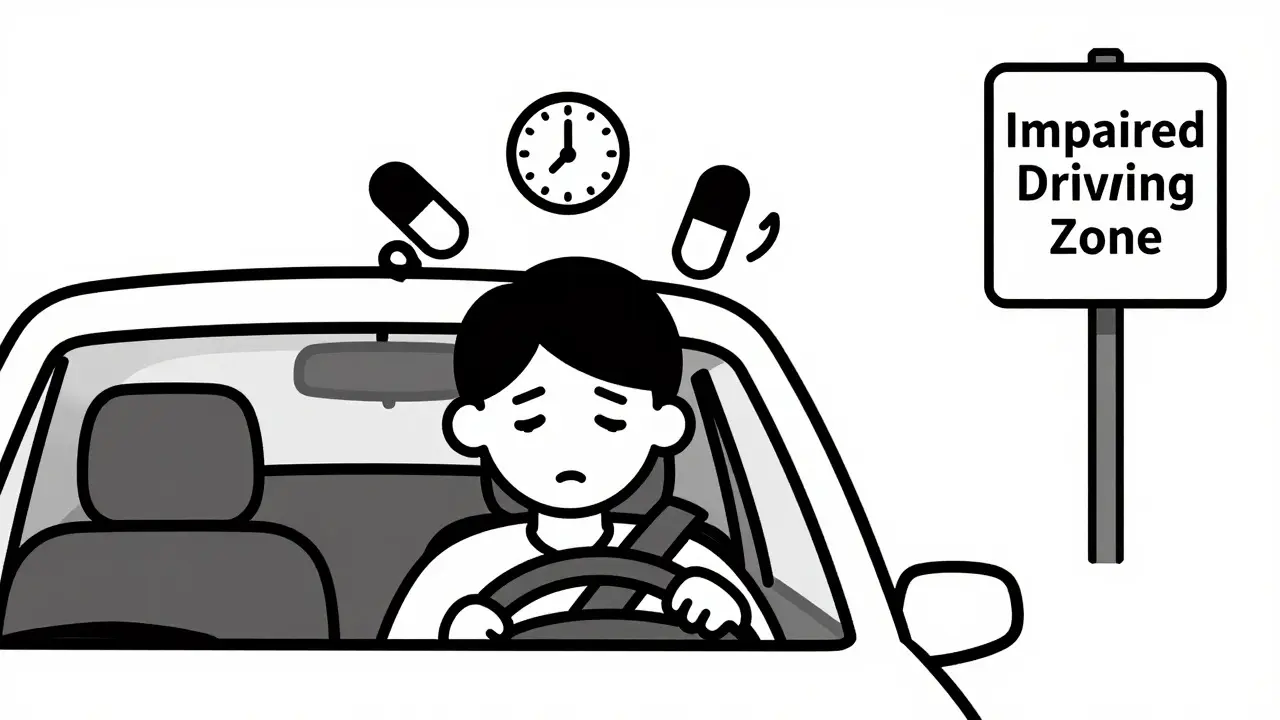
Many people don’t realize that taking their daily medication could be as dangerous as drinking alcohol behind the wheel. Whether it’s a sleep pill, painkiller, antihistamine, or antidepressant, these drugs can slow your reaction time, blur your vision, or make you drowsy without you even noticing. And when you get behind the wheel, that’s not just risky-it’s illegal.
How Medications Slow You Down
It’s not just about feeling sleepy. Medications affect your brain’s ability to process information, coordinate movements, and react quickly-all of which are critical for driving. For example, benzodiazepines like alprazolam or diazepam can reduce your brain’s processing speed by 25% to 40%. That means if a car suddenly stops in front of you, you might not react in time. Opioids like oxycodone don’t just make you drowsy-they narrow your pupils, blur your vision, and delay your reaction time by up to 300 milliseconds. That’s longer than it takes to blink.
Even common over-the-counter drugs carry hidden dangers. Diphenhydramine, the active ingredient in Benadryl and Tylenol PM, can impair driving just as much as a blood alcohol concentration (BAC) of 0.10%. That’s above the legal limit of 0.08% in every U.S. state. You might think, “I took it last night-I’m fine this morning.” But studies show that diphenhydramine can linger in your system for hours, and many people don’t realize they’re still impaired.
NSAIDs like ibuprofen and naproxen aren’t usually thought of as driving risks, but research from LeRoy and Morse found that people taking these drugs had a 58% higher chance of being in a crash. And antidepressants? Tricyclic antidepressants and mirtazapine have been linked to a 40% increase in motor vehicle accidents, according to a 2014 review in the Journal of Clinical Psychiatry.
The Real Cost: Crashes, Deaths, and Legal Trouble
The National Highway Traffic Safety Administration (NHTSA) reports that about 18% of fatal crashes involve drugs-not just illegal ones, but prescription and over-the-counter medications too. That’s second only to alcohol as a cause of preventable traffic deaths.
What makes this worse is that many drivers don’t know they’re impaired. A 2021 survey of over 2,600 drivers found that 5% admitted to driving within two hours of taking a prescription drug known to cause drowsiness. Even more alarming: 37% of people said they’ve ridden in a car with someone who had recently taken multiple drugs-even though 85% of those same people said they’d feel extremely unsafe doing so.
Legally, driving under the influence of medication is treated the same as drunk driving in most states. In fact, 28 states have specific legal limits for prescription drugs in your bloodstream. If you’re pulled over and found to have even trace amounts of a drug like diazepam or oxycodone in your system, you can be charged with DUI. Unlike alcohol, there’s no simple breathalyzer test for most medications. Instead, officers rely on field sobriety tests, blood samples, or saliva tests-which are still being rolled out. But that doesn’t mean you’re safe. If you cause an accident while on medication, you’ll be held fully responsible, even if you thought you were “fine.”
Who’s Most at Risk?
Older adults are especially vulnerable. As we age, our bodies process drugs differently. The liver and kidneys don’t clear medications as quickly, and brain receptors become more sensitive. That means a dose that was safe at 50 might be dangerous at 70. The American Geriatrics Society’s Beers Criteria lists over 30 medications that should be avoided in adults over 65 because of their impact on driving. These include sleeping pills like zolpidem (Ambien), which can impair you for up to 11 hours after taking it-even if you feel wide awake.
People taking multiple medications are also at higher risk. A 2020 study from the Pacific Institute for Research and Evaluation found that 22% of drivers in trauma centers had multiple drugs in their systems. The problem isn’t just one drug-it’s how they interact. Mixing a painkiller with a sleep aid and an antihistamine can create a “synergistic effect,” where the combined impairment is far worse than any single drug alone.
What You Should Do
Here’s what actually works, based on real data and expert guidelines:
- Read the label-not just the warning, but the fine print. Look for phrases like “may cause drowsiness,” “do not operate machinery,” or “avoid driving.” If it says that, assume it applies to driving.
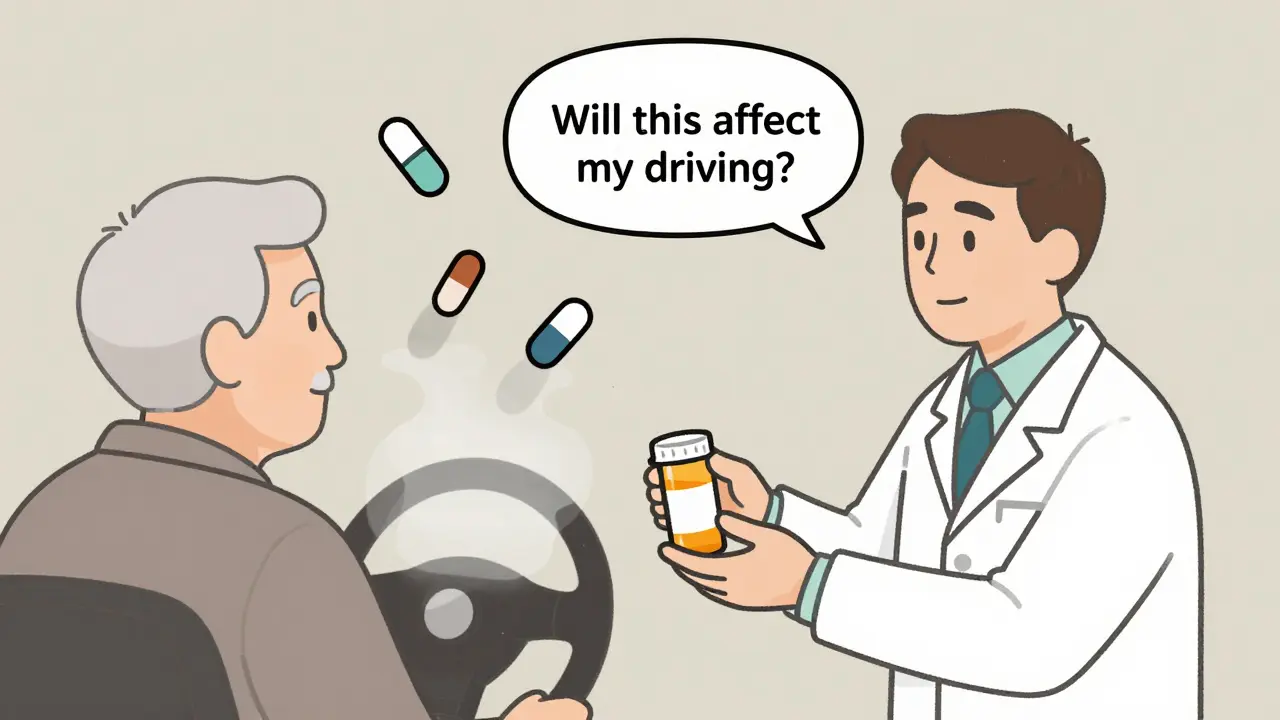
- Ask your pharmacist when you pick up a new prescription. They’re trained to spot interactions. The American Pharmacists Association now recommends 12 specific counseling points for patients about driving risks. Don’t be shy-ask, “Will this affect my ability to drive safely?”
- Wait longer than you think. For first-generation antihistamines like diphenhydramine, wait at least 6 hours. For sleep aids like zolpidem, wait 8 to 12 hours. If you’re not sure, don’t drive.
- Use a self-assessment. Before driving, ask yourself: Am I slower than usual? Do my eyes feel heavy? Can I focus on two things at once? If the answer is yes, take a nap or call someone else.
- Keep a medication log. Write down what you took, when, and how you felt afterward. Over time, you’ll learn which drugs affect you and how long the effects last.
Why Warning Labels Aren’t Enough
Most medication labels just say “may cause drowsiness.” That’s vague. It doesn’t say how long the effect lasts, how strong it is, or whether it gets worse with age. A 2021 FDA review found that only 32% of drug package inserts gave specific timeframes for driving restrictions. That’s why so many people think they’re fine after a few hours-when they’re not.
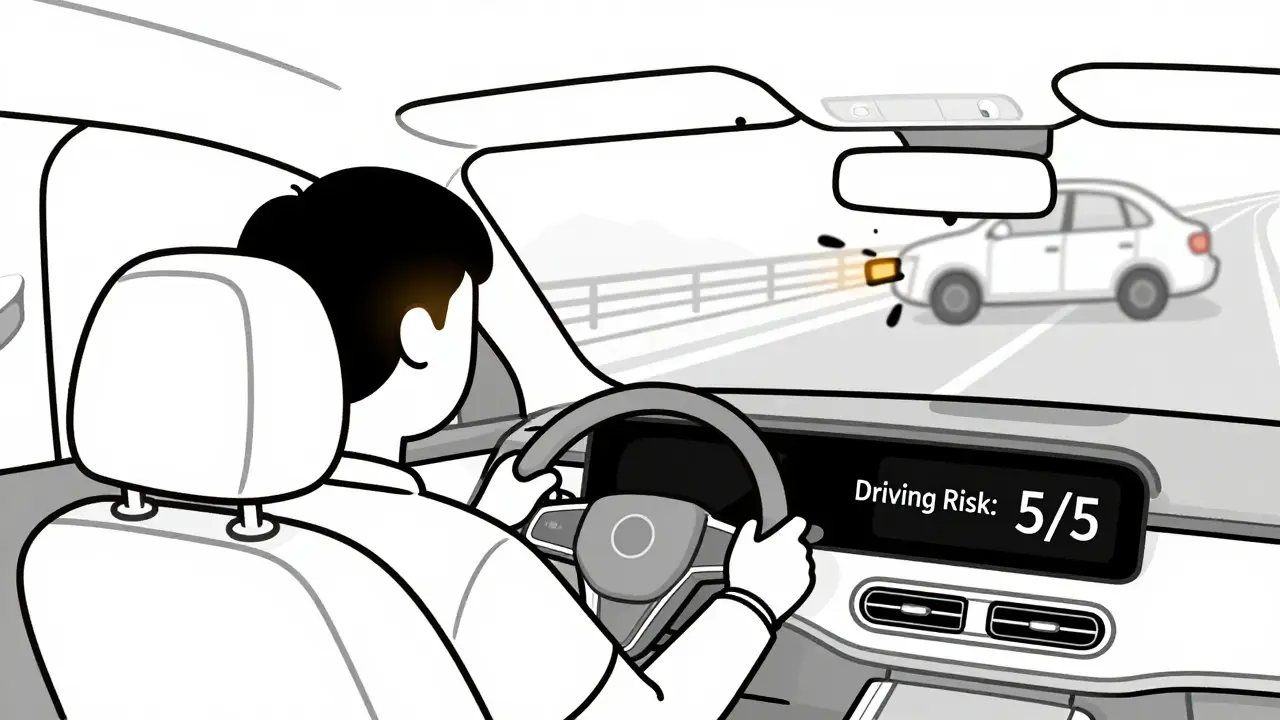
That’s changing. In May 2023, the FDA began requiring “Driving Risk Scores” on labels for CNS-acting drugs. These range from 1 (minimal risk) to 5 (severe risk). But not all drugs have been updated yet. Until then, don’t rely on the label alone.
The Future: Cars That Can Tell If You’re Impaired
By 2027, most new cars will have systems that monitor your eyes, steering, and reaction time to detect signs of impairment. These systems use cameras and sensors to spot drooping eyelids, erratic lane drifting, or delayed responses. If you’re impaired, the car might alert you, slow down, or even stop. It’s not a replacement for responsible behavior-it’s a last line of defense.
But technology won’t fix the root problem: people don’t know how their meds affect them. And that’s why education matters more than ever.
Final Thought: It’s Not Worth the Risk
You take your medication because it helps you feel better. But if you drive while impaired, you’re not just risking your life-you’re risking someone else’s. A single decision to get behind the wheel after taking a sleep aid or painkiller can change everything. There’s no excuse. If you’re unsure, don’t drive. Wait. Call a ride. Sleep it off. Your safety-and the safety of others-isn’t something you can gamble with.
Can I drive after taking Benadryl?
No, you should not drive after taking Benadryl or any product containing diphenhydramine. Even if you feel alert, the drug can impair your reaction time, coordination, and vision to the same degree as a blood alcohol concentration of 0.10%, which exceeds the legal limit in all U.S. states. Effects can last 6 to 12 hours, and some people experience residual drowsiness the next morning.
Do all prescription drugs affect driving?
No, but many do. Medications that affect the central nervous system-like sleep aids, painkillers, anti-anxiety drugs, antidepressants, and antihistamines-are most likely to impair driving. Newer antihistamines like loratadine (Claritin) or cetirizine (Zyrtec) have much lower risks. Always check the drug’s category and warning label, and ask your pharmacist if you’re unsure.
Is it legal to drive while taking prescribed medication?
It’s legal to take prescribed medication-but not if it impairs your ability to drive safely. In most states, you can be charged with DUI even if the drug was prescribed, as long as it affected your driving. Having a prescription is not a legal defense. If you cause an accident or are pulled over and found impaired, you’ll face the same penalties as someone driving drunk.
How long should I wait after taking a sleep aid before driving?
For zolpidem (Ambien) and similar sleep aids, wait at least 8 to 12 hours. Studies show these drugs can impair driving performance for up to 11 hours after ingestion, even if you feel awake. The FDA recommends waiting until you’re completely alert. If you’re unsure, don’t drive-use public transport or a ride service.
Why don’t doctors always warn patients about driving risks?
A 2022 national survey found that only 41% of physicians routinely discuss driving risks when prescribing potentially impairing medications. Many assume patients know, or they don’t have time. But patients often don’t realize the danger. That’s why it’s critical to ask your doctor or pharmacist directly: “Will this affect my ability to drive?” Don’t wait for them to bring it up.

Comments
10 Comments
Johny Prayogi
Bro seriously though, I took Benadryl last night for allergies and drove to work. Felt fine. Until I nearly sideswiped a mailbox. Now I keep a nap pad in the car. 🛌😂
Bryan Woody
The FDA’s new Driving Risk Scores are a start but let’s be real - most people don’t read labels. I’ve seen prescriptions with warnings so small you need a magnifying glass and a PhD in pharmacology to read them. Meanwhile, your pharmacist is just scanning the barcode and handing you the pill like it’s a candy bar. 🤷♂️
Natali Shevchenko
I used to think if I didn’t feel sleepy, I was fine. Then I got into a fender bender after taking a low-dose muscle relaxer. Turned out my reaction time was 0.8 seconds slower. That’s like driving blindfolded for 15 feet. Now I log every med I take and how I feel afterward. It’s weirdly therapeutic. Like journaling but with more panic.
Sandy Wells
I read this whole thing and still think most people are just being dramatic. I’ve been on antidepressants for 12 years and I drive like a ninja. If you can’t handle your meds don’t take them. Simple as that
Shaun Wakashige
Lmao imagine being scared of your own prescriptions. Next they’ll ban coffee before driving. 🤡
Allison Priole
I used to be like Sandy - 'I'm fine, I'm fine' - until my mom got pulled over for 'impairment' after taking her nighttime pain med. She cried for three days. Now I check in with her every time she takes something new. It’s not about fear. It’s about love. And maybe a little bit of panic. 😔
Paul Cuccurullo
The real tragedy isn’t the drugs - it’s the silence. No one talks about this. Not in doctor’s offices. Not in car commercials. Not even in family dinners. We treat medication like it’s a magic pill with no strings attached. But it’s not. It’s a chemical negotiation with your nervous system. And we’re all just guessing at the terms.
Solomon Kindie
The system is rigged. Pharma companies know these drugs are dangerous but they dont wanna lose sales so they bury the warnings in tiny font. And then they pay doctors to prescribe them. And then we get charged with DUI. Its not a coincidence its a business model. And dont even get me started on how the FDA gets funded by the same companies they regulate. 🤫
Nishan Basnet
In India, we have this phrase - 'Dawa ka asar, saath chalta hai' - the effect of medicine travels with you. We don’t need FDA scores or studies to know that. We’ve seen grandpas fall asleep at the wheel after their arthritis pills. We’ve seen young men crash after taking painkillers before long drives. The answer isn’t just tech or laws. It’s culture. We need to talk about this like we talk about alcohol. Openly. Honestly. Without shame.
Nicole James
I’ve been following this for years. Did you know the government has been secretly testing driver-monitoring tech in 47 states since 2021? And they’ve been quietly collecting data on every prescription you’ve ever taken? They’re building a database. They’re calling it 'Pharma-DriveWatch'. I saw the memo. They’re planning to link your EHR to your license plate. You think this is about safety? It’s about control.
Write a comment