
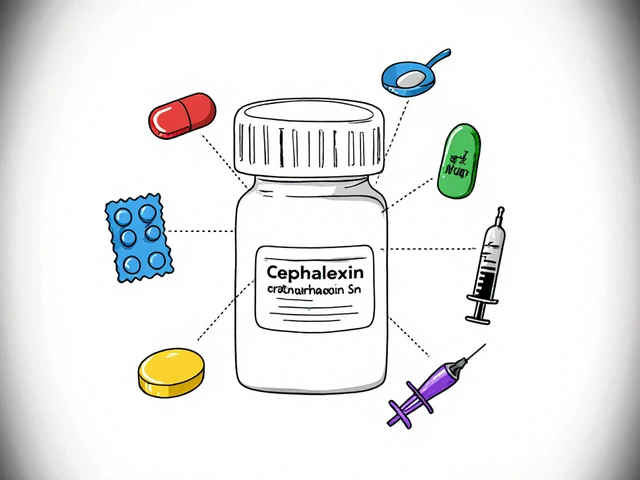
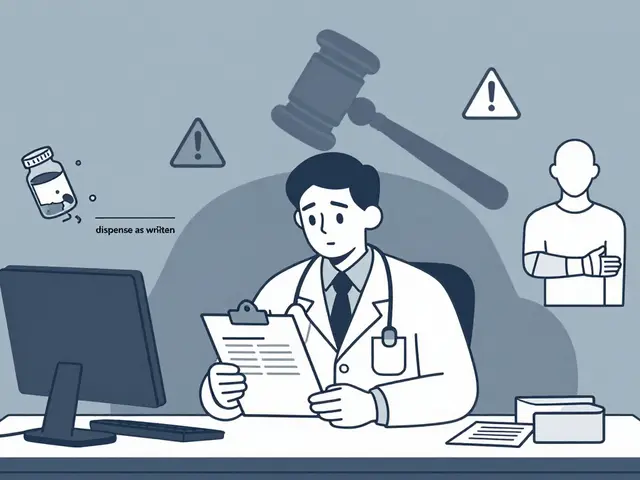
Every year, thousands of patients are harmed because a medication was given wrong - not because the doctor wrote the wrong dose, but because no one caught it before it went in. The truth is, most medication errors happen quietly, often in the rush between shifts, during a code, or when everyone’s tired. But there’s one safety step that’s saved lives again and again: the independent double check. And not every medication needs it. Only the high-alert ones.
What Makes a Medication "High-Alert"?
High-alert medications aren’t necessarily used more often. They’re dangerous because even a small mistake can kill. A typo on a label. A misread decimal. A pump set to 10 times the right dose. These aren’t hypotheticals. In 2023, ECRI Institute reported that properly done double checks stop 95% of errors from reaching patients. But only if they’re done right. The Institute for Safe Medication Practices (ISMP) keeps the official list, updated every two years. Their 2024 list identifies 19 categories of drugs that demand extra caution. These aren’t just "strong" drugs - they’re drugs where the margin between help and harm is razor-thin. For example:- IV insulin - one wrong decimal point can send a patient into a coma
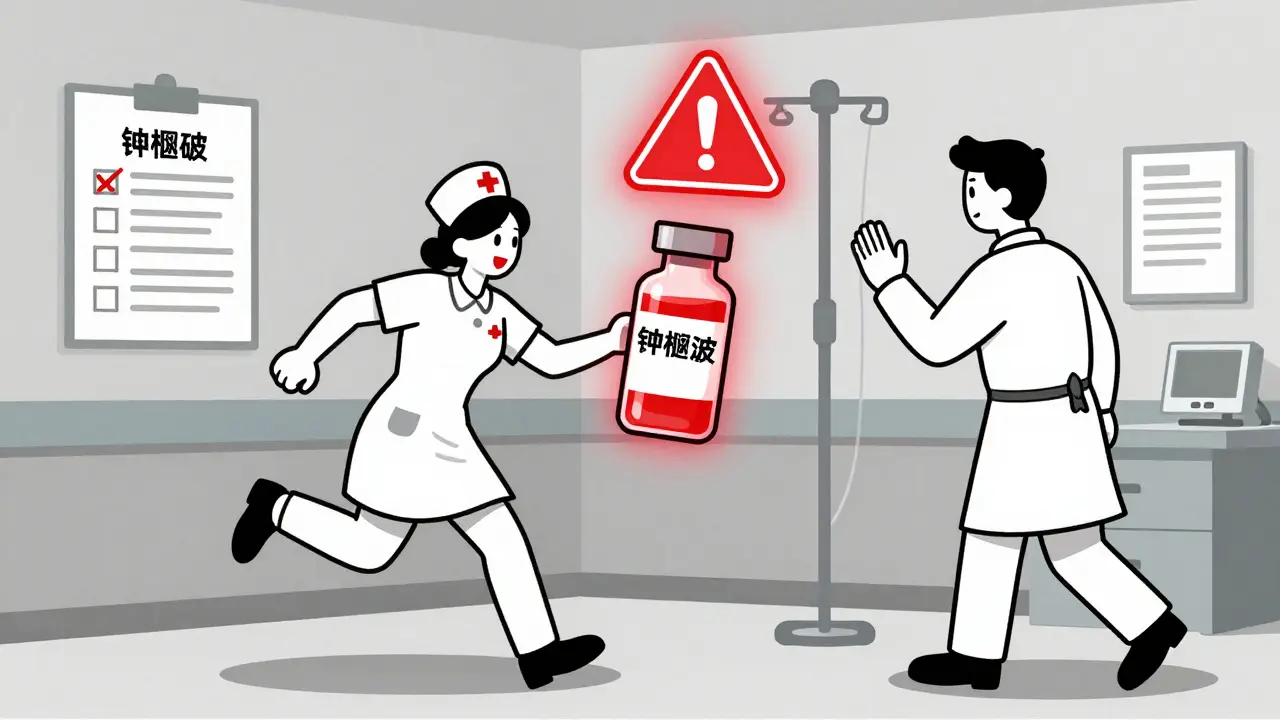
- Potassium chloride concentrate - a single IV push of undiluted potassium stops the heart
- Neuromuscular blockers - these paralyze muscles. If given without intubation, the patient suffocates
- Heparin infusions - too much causes internal bleeding; too little, and the clot forms
- Chemotherapy agents - even small overdoses can destroy bone marrow
- Injectable narcotic PCAs - patients can overdose if the settings are wrong
When Is a Double Check Required?
Not every high-alert medication needs a double check every time. That’s the myth. The ISMP says bluntly: "Overusing manual double checks makes them useless." If you’re checking everything, you start checking nothing. The real standard is risk-based. You double check the ones where the consequences are worst, and where human error is most likely. Here’s what most hospitals follow (based on ISMP 2024 and VHA Directive 1195):- All IV insulin - whether it’s a push or an infusion
- All concentrated potassium or phosphate - anything above 1 mEq/mL
- All heparin infusions - including flushes over 100 units/mL
- All neuromuscular blockers - unless the anesthesiologist is managing the whole process
- All chemotherapy agents - no exceptions
- Injectable narcotics in PCA pumps
- Total parenteral nutrition (TPN) and lipids
- Continuous renal replacement therapy (CRRT) solutions
What Does a Real Double Check Look Like?
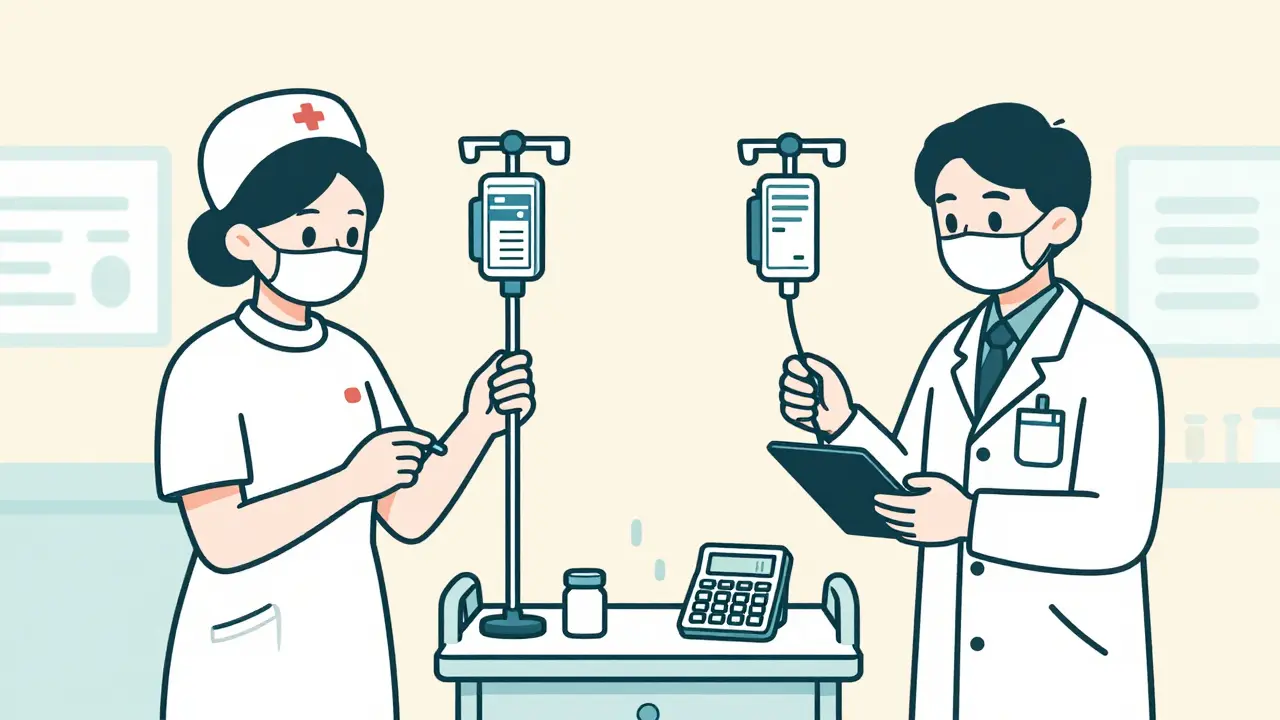
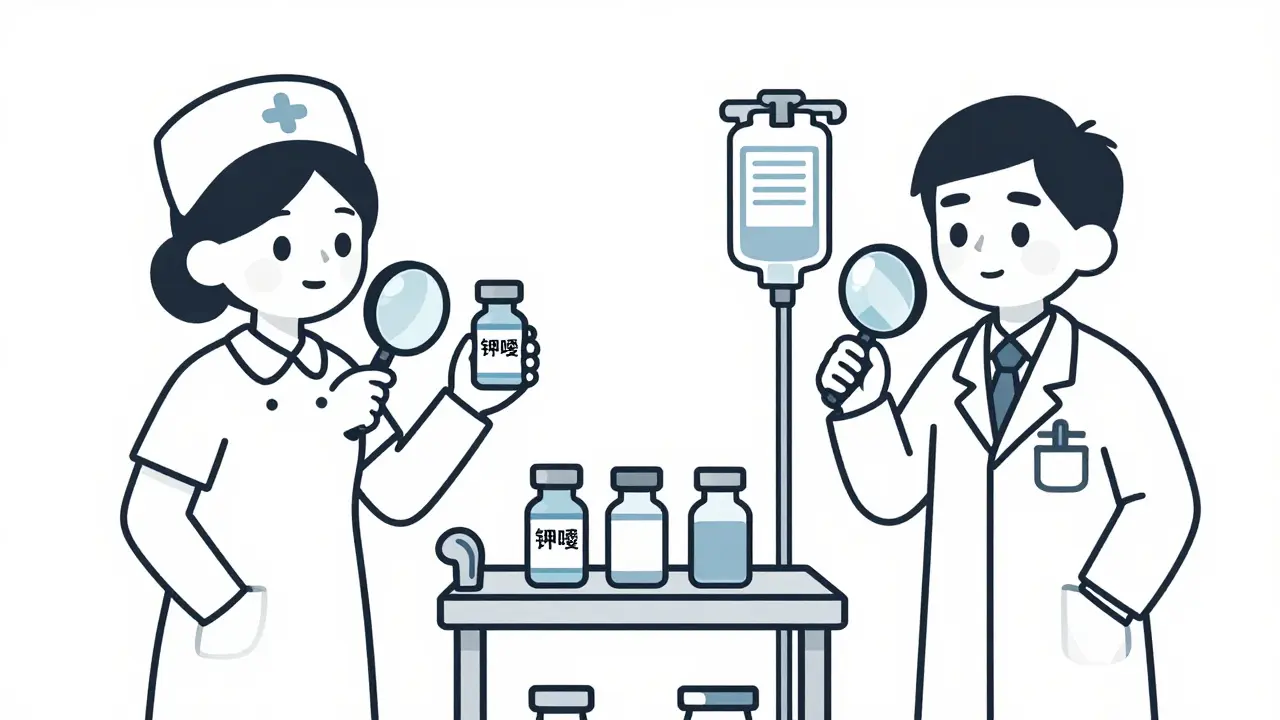
A double check isn’t two people standing next to each other nodding. That’s not a check - that’s a ritual. A true independent double check (IDC) follows strict rules:- Two licensed clinicians - one nurse, one pharmacist, or two nurses - work alone, apart from each other.
- Each checks all five rights: right patient, right drug, right dose, right route, right time.
- They verify the pump settings, concentration, and infusion rate - not just the label.
- They calculate the dose independently - no peeking at each other’s math.
- Only after both have finished, they compare results. If there’s a mismatch, they stop.
Why Do Double Checks Fail?
They don’t fail because the rules are bad. They fail because the system is broken. Here’s what goes wrong in real life:- Time pressure - Nurses say they don’t have time. One ICU nurse on Reddit said she caught three errors in six months - but saw 12 rushed checks where the second person didn’t even look at the pump.
- Staff shortages - In the ER, 82% of nurses say there’s never a second nurse available during a code.
- Ambiguous rules - 38% of errors in a 2021 ISMP study came from unclear checklists. "Check the dose" isn’t enough. You need to say: "Calculate the total units per hour and verify against the order."
- Documentation overload - Signing two electronic names adds 1.5 to 3 minutes per med. That’s time taken from other patients.
How to Fix It
You can’t fix this with posters or memos. You fix it with systems. Here’s what works:- Use technology - Smart pumps that auto-calculate doses and flag errors cut errors by 63%. E-prescribing and eMAR systems that require two digital signatures are now standard in 78% of top hospitals.
- Train like it matters - Cleveland Clinic requires a 2-hour competency session with a 95% pass rate. Nurses don’t just watch a video - they practice with real scenarios, including fake errors.
- Build time into the schedule - Mayo Clinic counts double-check time as part of nursing workload. If a nurse needs 2 minutes for an insulin check, they’re not penalized for being "slow." They’re supported.
- Start with data - Don’t check everything. Look at your own error logs. Which meds caused harm last year? That’s your list.
- Leadership must back it - If managers praise speed over safety, double checks will vanish. The best units have leaders who say: "If you’re not doing the check, you’re not doing your job."
The Future: Less Manual, More Smart
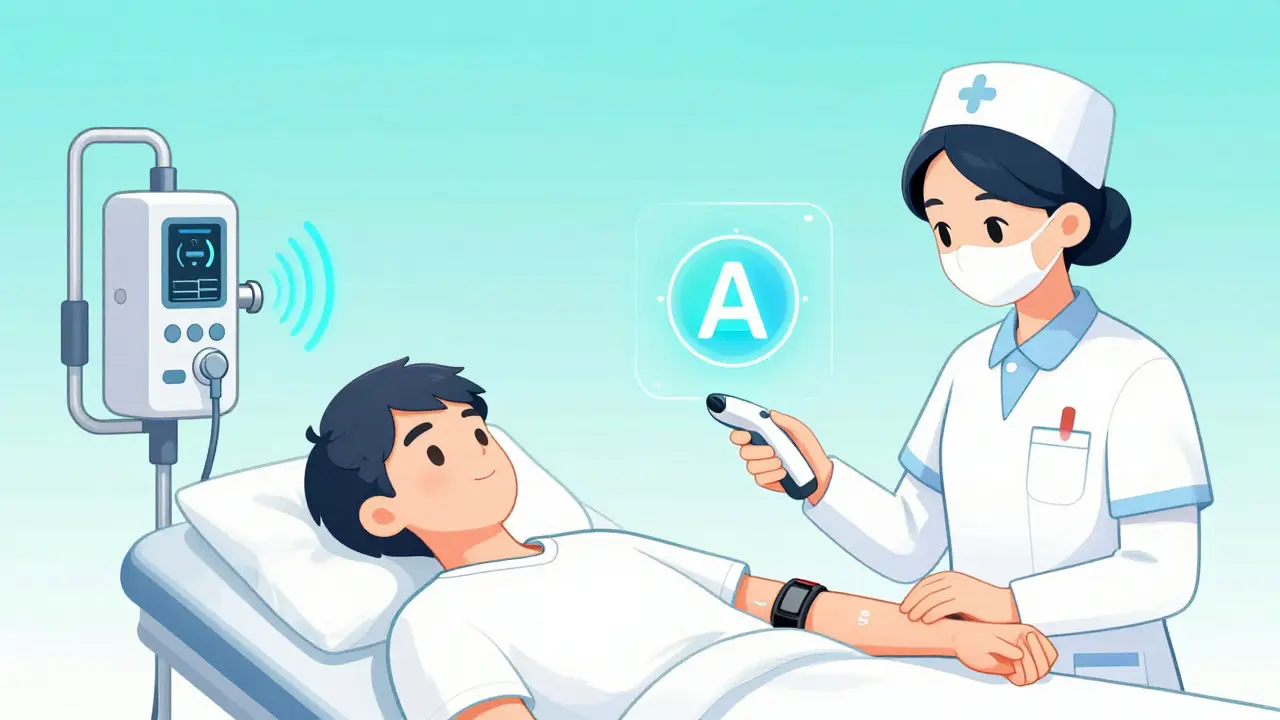
The era of manual double checks for every high-alert med is ending. ECRI Institute predicts a 40% drop in manual checks by 2028. Why? Because better tools are here:- Smart pumps that auto-calculate and lock out unsafe doses
- AI tools in pilot at 12% of academic hospitals - they flag mismatches between order and pump settings
- Barcode scanning that links patient ID, drug, and dose in real time
What You Can Do Today
If you’re a nurse, pharmacist, or clinician:- Know your hospital’s official high-alert list. If you don’t, ask for it.
- Ask: "Is this check independent?" If you’re talking while checking, it’s not.
- Don’t sign off if the second person didn’t verify the pump settings.
- Report when double checks are skipped because of staffing. It’s not a complaint - it’s a safety alert.
- Stop requiring double checks for low-risk meds. It trains people to ignore them.
- Invest in smart pumps and eMAR systems with dual-signature requirements.
- Track error rates before and after changes. If errors drop, you’re doing it right.
Final Thought
Medication safety isn’t about rules. It’s about culture. It’s about choosing to pause - even when you’re rushed - because you know what’s at stake. One nurse in a 2023 Reddit thread wrote: "I once caught a 100-fold overdose in potassium. The patient was stable. The nurse who ordered it didn’t even realize. I didn’t get a medal. But I didn’t need one." That’s the point. You don’t need applause. You need to be the one who checks - the one who doesn’t look away.What are the most common high-alert medications that require a double check?
The most common high-alert medications requiring independent double checks include IV insulin, concentrated potassium chloride (1 mEq/mL and above), neuromuscular blocking agents, heparin infusions (especially above 100 units/mL), chemotherapy agents, and injectable narcotic patient-controlled analgesia (PCA) pumps. These are listed in the 2024 ISMP High-Alert Medications List and are required by most U.S. hospitals under Joint Commission standards.
Is a double check always necessary for every high-alert medication?
No. The Institute for Safe Medication Practices (ISMP) advises against universal double checks because overuse leads to complacency. Instead, double checks should be reserved for the highest-risk medications - like IV insulin, concentrated electrolytes, and chemotherapy - where the consequences of error are most severe. Hospitals should base their list on local error data, not blanket policies.
What’s the difference between a "simultaneous" and an "independent" double check?
A simultaneous check happens when two people check together - one reads the label while the other nods along. This creates bias and misses errors. An independent double check means two licensed clinicians verify the medication alone and apart from each other. Only after both finish do they compare results. Independent checks are 87% effective at catching errors; simultaneous checks drop to 32%.
Why do nurses sometimes skip double checks?
Nurses skip double checks due to time pressure, staffing shortages, unclear protocols, or fatigue. In emergency settings, 82% report no second nurse is available during critical events. Some see the process as redundant, especially if they’ve never seen an error. But when errors are caught - like a 100-fold potassium overdose - nurses confirm the check saved a life.
Can technology replace manual double checks?
Technology doesn’t replace human judgment - it supports it. Smart pumps with dose error reduction systems, eMAR systems requiring dual signatures, and barcode scanning have reduced high-alert medication errors by 63% in hospitals that use them. However, for the most dangerous drugs - like chemotherapy or IV insulin - human verification remains essential. The future is hybrid: tech catches obvious mistakes, and humans verify complex cases.
How can hospitals improve compliance with double checks?
Hospitals improve compliance by building time into workflows, providing mandatory competency training (like Cleveland Clinic’s 2-hour module), using technology to automate verification steps, and ensuring leadership supports safety over speed. Auditing compliance and sharing error-reduction results - like Johns Hopkins’ drop from 12.7% to 2.3% heparin errors - also builds trust in the process.
Comments
13 Comments
Melodie Lesesne
Just read this after my night shift and honestly? I cried a little. We had a near-miss last week with potassium and no one even looked at the pump. I stopped it, but I felt so alone doing it. Thanks for putting this out there.
Corey Sawchuk
Been doing this for 15 years and the only thing that changed is the paperwork. The checks are still rushed. I’ve seen the same nurse sign off while scrolling TikTok. No joke.
Rob Deneke
If you're not doing the double check you're not doing your job. Period. I don't care if you're tired or short staffed. That's why we have protocols. Safety isn't optional.
evelyn wellding
YESSSS!! 🙌 I caught a 10x insulin dose last month because my partner actually looked at the pump settings instead of just nodding. We high-fived like we won the lottery. This is why I still love nursing 😭💖
Chelsea Harton
human error is real but so is system failure. fix the system not the nurse
Corey Chrisinger
It’s funny how we treat meds like they’re magic wands. One wrong number and boom - life or death. But we still treat nurses like robots who shouldn’t need time to breathe. We’re not machines. We’re humans trying not to kill people while being yelled at by admins.
Smart pumps? Yes. But also? Give us 2 minutes. That’s all.
Bianca Leonhardt
Of course you’re not catching errors. You’re all too busy checking boxes. The real problem? Leadership doesn’t care until someone dies. And even then they’ll blame the nurse. Again. Always the nurse.
Travis Craw
we used to do real double checks back in 2018 but now everyone just signs the echart and walks away. i dont blame them. the system is broken
Jody Fahrenkrug
My hospital just added ketamine to the list. Took them 3 years. We’ve had 2 near-misses already. I’m glad they’re finally listening. But I still don’t trust the new smart pumps - they glitch when the Wi-Fi is slow.
kanchan tiwari
THEY KNOW. THEY ALL KNOW. The pharmaceutical companies push these drugs because they’re profitable. The double check? A distraction. A placebo. They want you tired, distracted, and signing forms so they can keep selling. This isn’t safety - it’s control.
They’re watching you. Always watching.
Bobbi-Marie Nova
Oh honey, I’m so glad someone finally said this. I’ve been begging my manager for years to stop making us double-check Tylenol. We’re not robots. We’re nurses. Let’s focus on the stuff that actually kills people. 🙏
Allen Davidson
Love this. Real talk. I’ve trained new nurses for 10 years and the ones who get it? They’re the ones who pause. Not the fastest. Not the loudest. Just the ones who care enough to check twice. Keep doing that. The system will catch up.
Ryan Hutchison
USA has the best hospitals in the world. Why are we even talking about this? We’ve got smart pumps, AI, barcode scanners. If you’re still making mistakes you’re just lazy. Get with the program. This isn’t 2005.
Write a comment